
Blog
Three Phase Stabilizer for Hospital

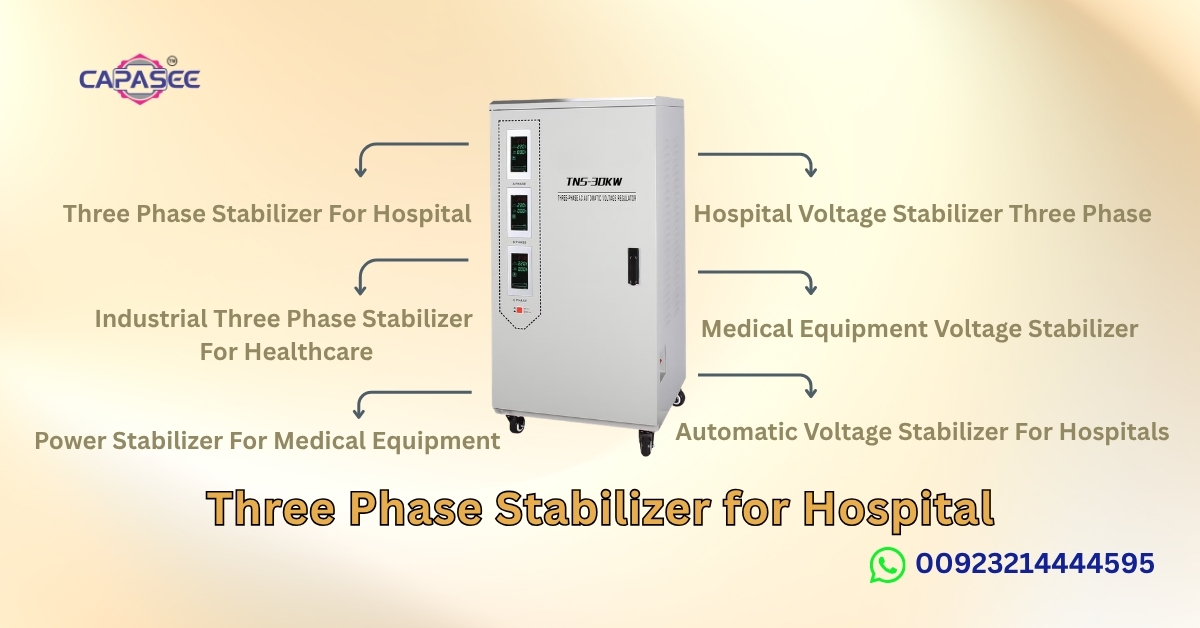
An electric failure in an operating theatre is not a technical inconvenience; it is a life threatening event in a hospital. The healthcare industry in Pakistan also relies on equipment that requires consistent and stable power at all times, but Pakistan’s electric grid is known for voltage dips, surges, and uneven distribution of three phase electricity. Which is why selecting the most appropriate three phase stabilizer for hospital environment has become one of the most crucial decisions that a hospital management or biomedical engineer will make for the health care infrastructure.
It doesn’t matter if you are installing a new hospital in Lahore or upgrading the electrical protection system of a clinic in Karachi; the stakes are just too high to leave to chance. Capasee Electro Medical Engineering here explains everything you need to know about the stabilizers, from how they work to what the necessary specifications are in clinical settings, and lets you make an informed and intelligent purchase.
What Is a Three Phase Stabilizer for Hospital and Why It Matters
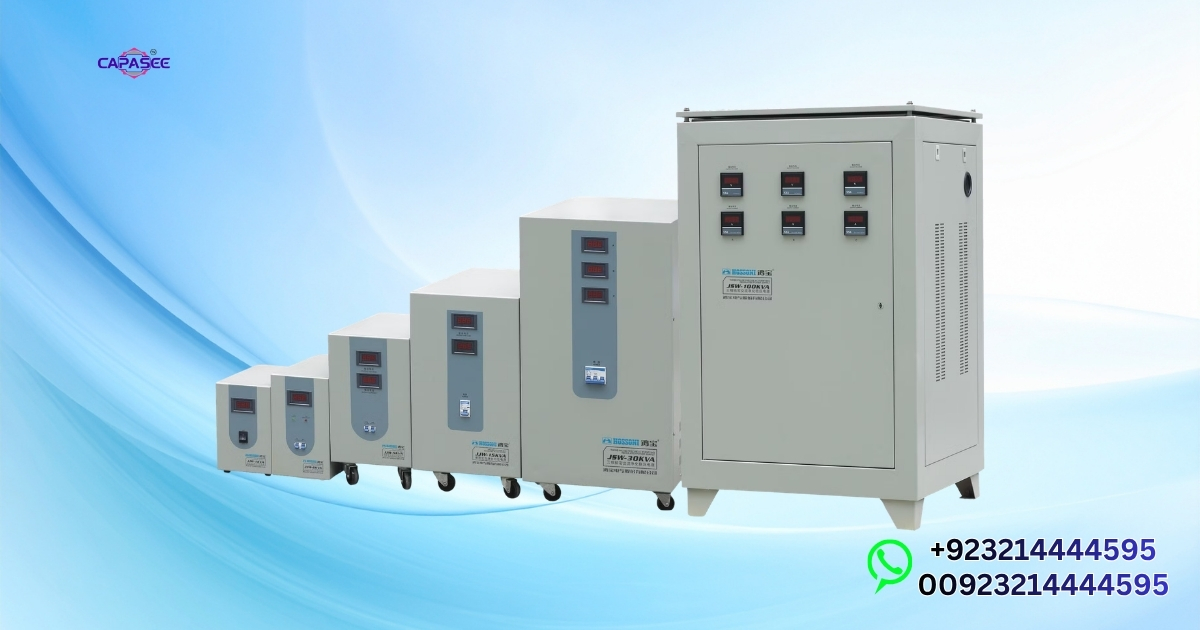
A three phase stabilizer for hospital use is a power conditioning unit that automatically corrects incoming voltage fluctuations on all three phases as the power passes through the stabilizer to the sensitive hospital equipment. It controls the total load of a facility throughout, as opposed to a single phase stabilizer, which only controls the output voltage when the load changes, and provides a stable output voltage throughout the facility when the grid supply fluctuates or fails unpredictably. This is not a luxury; it’s a necessity for hospitals relying on a three phase stabilizer for hospital operations.
We’ve seen what happens at clinical facilities that don’t invest in power protection at Capasee Electro Medical Engineering. Ventilators trip up and throw error codes, imaging machines throw error codes, and surgical lights flicker during procedures. All of that is taken away by a properly rated stabilizer, which buffers between the unstable grid of Pakistan and the equipment that is saving lives.
How a Three Phase Stabilizer Protects Critical Hospital Equipment
From a simple infusion pump to a high resolution MRI machine, every type of hospital equipment has a very narrow voltage tolerance range. If the supply voltage is outside this range, they either automatically turn off for self protection or, even worse, continue to run under conditions that are harmful, thereby reducing their lifespan. This is achieved by a three phase stabilizer for hospital, which identifies the deviations and recovers from them within milliseconds before any damage can be done to the load.
Let’s take an example, a 200 bed hospital in Faisalabad using municipal supply, which experiences a regular voltage drop to 320V during peak hours. Otherwise, they would be subjected to power surges again in their ICU monitors and dialysis machines. When the stabilizer is set up correctly by the Capasee, the output will remain constant at 380V to 400V, even if the input voltage fluctuates. This level of reliability is the reason patients stay safe.
You May Also Read This Blog: Stabilizer for Refrigerator in Pakistan
Why Hospitals in Pakistan Need Stable Voltage for Uninterrupted Care
The country’s national grid is always put to the test by seasonal overloads, lack of infrastructure, and industrial demand. Many cities have voltages ranging between 300V and 450V on a three phase supply, much higher than is safe for most medical devices to operate at. Hospitals using raw grid power without stabilisation are literally playing with their equipment and patients’ lives each day.
Protection of equipment is not the only compliance risk posed by voltage instability. The biomedical engineers who are responsible for maintaining hospital equipment understand that manufacturers tend to waive warranties on equipment when damage is caused by irregularities in the supply. A three phase stabilizer for hospital use is a clinical and financial decision.
Choosing the Right Three Phase Stabilizer for Hospital
Choosing the right stabilizer requires knowledge of the total connected electrical load at your hospital. Selection by guesswork is impossible; if a stabilizer is too small, it will have to work at full load all the time and will be subject to overloading and failure. Oversizing is a drain on capital spending. The best one is something that’s not too extreme, but not too easy, either.
Capasee Electro Medical Engineering collaborates with Hospital Procurement Departments and Biomedical Departments in Pakistan to determine the actual load requirement of a unit before recommending it. The consultative approach is to provide the hospitals in Multan, Peshawar, and Quetta with the stabilizers that are actually required in their actual operations, and not some rough estimates.
Three Phase Stabilizer Capacity Guide for Hospital Loads
A stabilizer’s capacity is measured in units of KVA (kilovolts amperes). Correct sizing of your facility is obtained by summing up all your equipment VA ratings and then adding a safety margin of 20% to 30%. A 100 Bed hospital with ICUs, Operation Theatre, Radiology, General ward loads, etc., requires a 100 KVA to 200 KVA stabilizer.
Here is a hands on approach to help you think. About 15 KVA to 25 KVA is consumed for a single operation theatre setup comprising lights, anesthesia machine, and monitors. A separate X-ray CT scan room can consume between 30 KVA and 60 KVA. If you multiply these numbers by several departments, the number of loads rapidly adds up, and it’s always essential to assess accurately before buying.
Key Features to Check Before Buying in Pakistan
There are not all stabilizers that are available in Pakistan, which are suitable for clinical conditions. Check the unit or manufacturer for a broad input voltage range (300V to 460V on three phases), low output voltage regulation (plus or minus 1% of 380V/400V), overload/short circuit, phase loss, and phase reverse protection. These are not extra features; they are all standard hospital amenities expected in a three phase stabilizer for hospital setup.
Also, it is best to check if the cooling system can operate for 24 hours a day. Most hospital environments can use air cooled units that have intelligent fan management. Oil cooled or forced air designs are more likely to be reliable, especially when operating under continuous load, for larger installations over 200 KVA. Capasee offers complete technical advice on how to select the appropriate cooling design for a particular setting.
Three Phase Stabilizer Specifications and Comparison
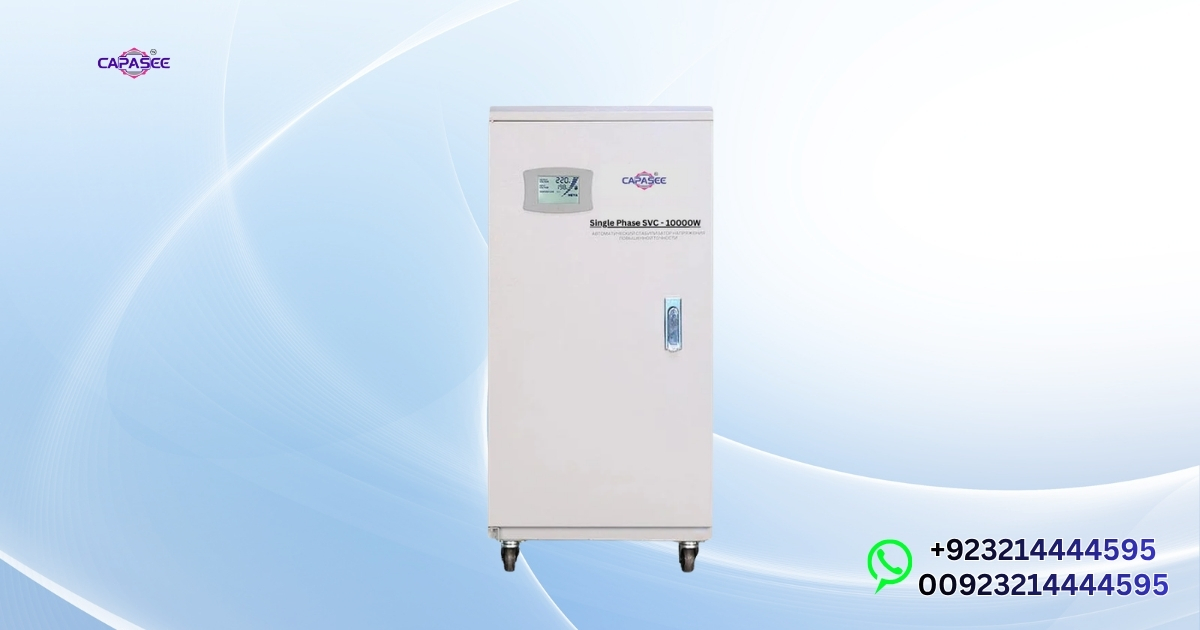
The technical specifications are what make a confident purchase from an expensive error for a three phase stabilizer for hospital. A specification sheet gives you a clear idea of what a stabilizer will do in actual conditions within your hospital, such as low voltage, surge, and high load operations. If you know what they mean, you are in control.
Before making a stabilizer installation recommendation, Capasee considered six fundamental technical parameters on a site for a three phase stabilizer for hospital. Each of them has a direct impact on the performance of the unit in a clinical scenario where failure is simply unthinkable.
Check More & Purchase: Our Products
Technical Factors That Affect Hospital Performance
One of the least known specifications is response time. A stabilizer that responds to voltage drops in two to three seconds is not suitable for life support environments that require equipment to respond to voltage drops in less than 100 milliseconds. Precision type stabilizers (servo controlled) are used for their accuracy but are slower to respond than static or relay type stabilizers. Static voltage regulators (SVR) are recommended for hospitals with critical care departments because of their quick response time in a three phase stabilizer for hospital setup.
Carefully consider the efficiency rating as well. When a stabilizer operates at 95%, the amount of energy losses as heat is less, resulting in less cooling load in the electrical room, and consequently reducing the electrical room’s operating costs over the long term. At a 2% to 3% efficiency difference, a 24 hour a day stabilizer in a hospital equates to a lot of savings over 5 years, especially when using a three phase stabilizer for hospital.
Three Phase Stabilizer Comparison Table for Hospital Use
Make sure to run each of the units you have shortlisted through this checklist before you purchase them. A paper stabilizer may seem attractive, but if it doesn’t meet one or more of these requirements in a clinical setting, it can become an expensive headache. Capasee had developed this reference table specially for the Hospital procurement departments, Biomedical Engineers, and Facility Managers in Pakistan facing tough power situations and selecting a three phase stabilizer for hospital.
Follow the table below for your side by side evaluation:
| Specification | What to Look For | Hospital Benefit |
| Capacity (KVA) | Match to total connected load plus 25% margin | Prevents overload and unexpected shutdowns |
| Input Voltage Range | 300V to 460V for three phase supply | Reliable protection during local power dips |
| Output Accuracy | Plus or minus 1% regulation at 380V or 400V | Safer, consistent performance for sensitive devices |
| Protection Features | Overload, short circuit, phase loss, phase reversal, time delay | Reduces risk of equipment damage and data loss |
| Cooling System | Efficient fan cooling or oil cooled for large KVA units | Supports continuous 24 hour clinical operation |
| Response Time | Under 20ms for critical care areas | Protects life support and monitoring equipment |
| Efficiency Rating | 95% or above | Lower energy waste and reduced operating costs |
When making comparisons or talking to suppliers, this table will provide your biomedical or procurement team with a handy checklist. Capasee Electro Medical Engineering offers all of the above specifications in writing before leaving our factory; hospitals will always be able to have documented performance guarantees on file for every three phase stabilizer for hospital.
FAQ’s
Is a three phase stabilizer necessary for medical equipment?
Yes, a three phase stabilizer for hospital applications is needed. When in use, medical devices such as ventilators, CT scanners, and ICU monitors depend on a steady voltage to operate safely. With Pakistan’s erratic power supply, it is imperative for the facility managers to stabilize the grid, rather than it being just an extra feature.
What size stabilizer is best for a hospital?
The size will depend on the total electrical load of the space. Total up all equipment KVA ratings and add 25 to 30% to this for a safety margin. Capasee Electro Medical Engineering provides free load assessment to make it easier for hospitals around Pakistan to select the optimum capacity without any guesswork.
What is the difference between servo and static stabilizers for hospitals?
Servo stabilizers have a higher level of output accuracy but have slower correcting speeds, which is suitable for general loads in the hospital. Static stabilizers can correct the voltage in less than 20 milliseconds, ideal for critical care operating environments such as ICUs and operating theatres.
How does a stabilizer improve equipment life in hospitals?
When the supply voltage is not consistent, internal stress develops in medical devices, which can be avoided by having a consistent voltage. That stress over time leads to premature component failure and expensive repairs. A well rated stabilizer can add several years to the service life of the equipment and can save many replacement costs for the management of the hospital.
How to choose a trusted hospital stabilizer supplier in Pakistan?
Seek a supplier that has proven their experience in biomedical/healthcare electrical installations, not just a general industrial supply. They must offer written technical details, local after sales, and at least a 2 year warranty. Capasee Electro Medical Engineering is engaged solely in medical grade power solutions in Pakistan.
How much maintenance does a hospital stabilizer need?
A well installed stabilizer can only be maintained by regular but minimal attention. Have professional checks every six months on terminal connections, cooling fans & voltage calibration. Capasee Electro Medical Engineering offers hospital scheduled maintenance contracts to ensure that hospitals never miss a maintenance service due to equipment inoperability, and always meet the requirements of the equipment protection standards.
Conclusion
Stable power is not the background to a hospital operation; it is a part of the clinical requirement that has a direct impact on patient outcomes and equipment reliability. There are three decisions to make when choosing the right three phase stabilizer for hospital applications size, specification, and supplier. With only a qualified supplier, you can be sure that your power infrastructure in the hospital survives reality.
You’ll have longer lasting equipment, a biomedical team that can spend less time troubleshooting failures, and clinical staff that can work with the knowledge that the power supply will not let them down, when you get this part right with a three phase stabilizer for hospital.
Request a no cost site evaluation and load calculation specific to your facility today from Capasee Electro Medical Engineering. Hospitals in Pakistan require power protection that is tailored for healthcare, and that’s what we provide.