
Blog
Stabilizer for CT Scan Machine


One uncontrolled vibration during a CT scan can lead to a single blurred diagnostic image, and there’s no room for error in medical imaging. If your CT scan images are blurry, have streaks, or are ghosted, it could be a sign of the underlying mechanical instability that many techs ignore until it’s too late. The CT scan machine stabilizer is the part of the CT machine that does just that, it stabilises the gantry and its assemblies so that they can deliver a diagnostic cross sectional image, much like a stabilizer for CT scan machine ensures overall system balance.
As the hospital industry in Pakistan expands, many diagnostic centres and hospitals are investing in CT equipment, but are still experiencing image quality problems due to damaged or missing stabilizers. In this article, we will explain the why, how, and what of a stabilizer and how Capasee Electro Medical Engineering can help you find and fit it perfectly, including the right stabilizer for CT scan machine.
Understanding the Necessity of a Stabilizer for CT Scan Machine
A CT scan machine is not only sensitive but also a diagnostic device that requires clean, stable, and continuous voltage at all times. Even a brief dip in the voltage can cause problems with the algorithms used for image reconstruction and result in “artefacts”, blurring, or doubling of structures. That’s why a stabilizer for CT scan machine is not just desirable; it’s essential.
In Pakistan, where an unstable power supply is a known issue, in cities like Lahore, Karachi, and Peshawar, diagnostic centres running CT scanners without stabilisers are unwittingly jeopardising both their equipment and their patients. An unwarranted power fluctuation during a scan not only destroys the image; it can also damage the CT detector array or X-ray tube, which costs millions of rupees to replace, reinforcing the need for a stabilizer for CT scan machine.
Why Sensitive Diagnostic Equipment Requires Precise Voltage Regulation
CT scanners are equipped with high frequency inverter circuits, rotating anode X-ray tubes, and digital detector panels that are designed to operate within a very limited range of voltage. A ±5% fluctuation in the input voltage can result in operating these components beyond their design limits. Over repeated cycles, this voltage instability leads to greater wear and tear of components and a shorter lifetime of the machine, which a stabilizer for CT scan machine helps prevent.
Medical grade voltage regulation is not only important for hardware protection. It directly affects imaging accuracy. With a stable power supply, the X-ray tube fires at the same kilovoltage, which is critical for producing diagnostically accurate Hounsfield unit values on each slice of the CT scan, something ensured by a stabilizer for CT scan machine.
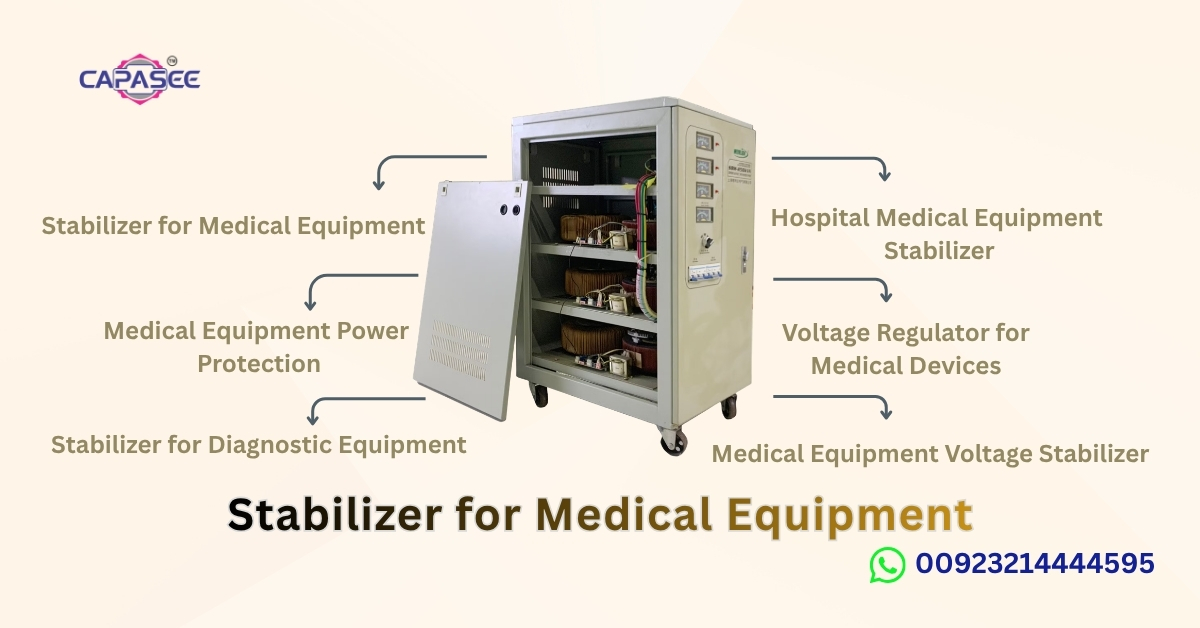
You May Also Read This Blog: Stabilizer for Medical Equipment
Comparing Standard vs. Servo-Based Stabilization for Medical Imaging
Unfortunately, many CT managers in Pakistan attach CT scanners to basic stabilizers that are designed for residential or low capacity commercial applications. These are not designed for the highly variable loads of imaging equipment. A medical stabilizer, on the other hand, uses electronic servo control to respond to changes in the voltage in milliseconds rather than mechanically, making it a reliable stabilizer for CT scan machine.
So the difference in performance is significant. It is the difference between reliable, diagnostic quality images and multiple scan repeats that cost time, money, and radiation dose, not to mention the cost of additional maintenance. The table below illustrates this:
| Feature | Standard Home Stabilizer | Servo-Based Medical Stabilizer |
| Response Time | Slow (Mechanical) | Ultra-Fast (Electronic) |
| Voltage Precision | Low (±10%) | High (±1%) |
| Load Handling | Small Appliance | Heavy-Duty Medical Loads |
| Waveform Quality | Unfiltered | Clean & Consistent |
Key Features of Capasee Electro Medical Engineering Stabilizers
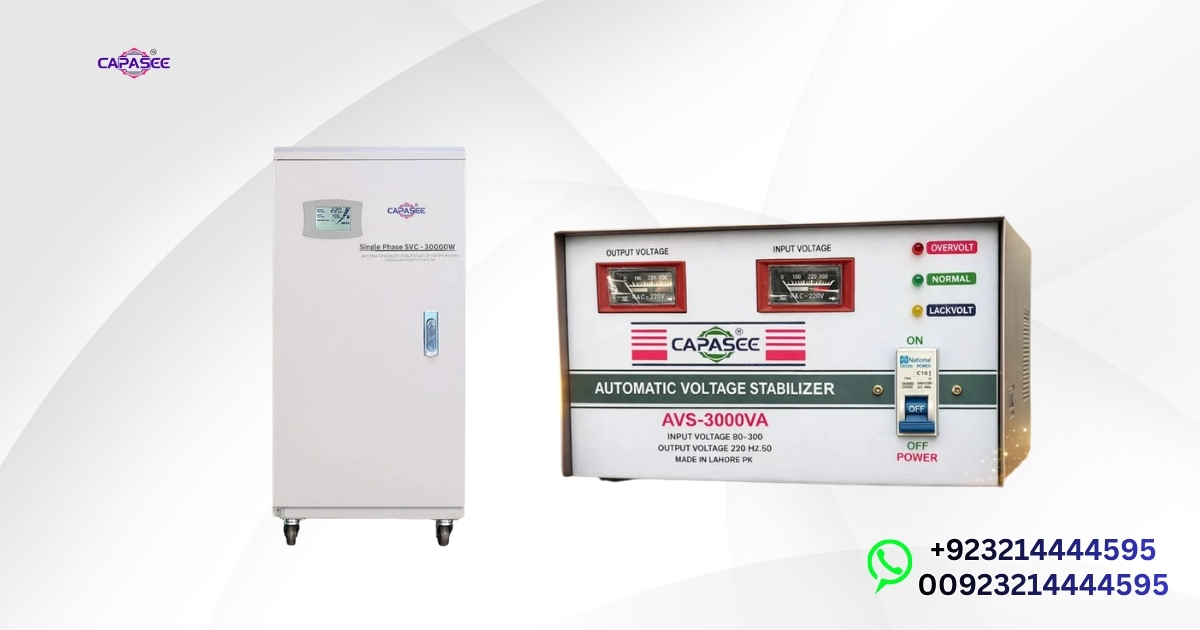
Capasee Electro Medical Engineering provides power stabilizers specifically designed with medical grade imaging rooms in mind. All of our stabilizers undergo load simulation testing based on the actual CT scanner environment, from cold startup inrush currents to peak scanning loads. Our stabilizers not only protect the voltage your scanner uses, but they also condition the complete power system as a dependable stabilizer for CT scan machine.
Unlike off the shelf stabilizers commonly found in the market, our stabilizers are designed with intent. Our stabilizers are built around copper wound transformers, electronic servo correction, and surge suppression circuitry that complies with international standards for medical equipment. Our stabilizers have already been installed in hospitals across Punjab, Sindh, and KPK with their CT scan equipment and have been demonstrated to improve image quality consistency and decrease unscheduled downtime using a stabilizer for CT scan machine.
Ensuring Uninterrupted Diagnostic Accuracy and Imaging Quality
A recurring gripe for radiologists is “noise” that suddenly occurs in CT images. Most often traced to engineering diagnostics, the source of the problem is unstable input power, rather than the CT scanner itself. This is completely avoidable with a correctly sized Capasee stabilizer that provides clean and stable output voltage directly to the scanner’s internal power supply, acting as a stabilizer for CT scan machine.
This is especially important in the case of multi slice acquisitions, where the system draws a varying current from all the detector rows at once. Our stabilizers ensure that the output voltage doesn’t change during these load transitions, meaning all the slices in the sequence are exposed to the same conditions (and therefore produce the same quality image throughout the entire scan volume) with the help of a stabilizer for CT scan machine.
Custom Design and Capacity Engineering for CT Scanners
At Capasee Electro Medical Engineering, we offer custom solutions to meet the power requirements of your CT scanner. Our CT scanner solutions are designed for 16 slice, 64 slice, or 128 slice models, which all have different KVA ratings, three phase arrangements, and inrush currents. There is no “average” stabilizer in a serious medical engineering practice, and we don’t supply one, especially when selecting a stabilizer for CT scan machine.
Our engineers examine the data sheet on your CT scanner before we recommend or supply a stabilizer for your site. This guarantees that the stabilizer we provide will not be too small (voltage drop while under load) or too large (waste of capital and space). You receive just what you need in a stabilizer for a CT scan machine.
Technical Considerations for Selecting a Medical-Grade Stabilizer for CT Scanners
When choosing a stabilizer, it’s not just price that matters. The true electrical demand of your CT scanner on the supply line, the quality of the power supply to your facility, and the suitability of the location for high power three phase equipment should be considered. Doing this wrong will cost them money, both in repairs and in downtime, when selecting a stabilizer for a CT scan machine.
Many facilities simply size a stabilizer based on the wattage of the CT scanner. Loads have current transients at startup up to three to five times the normal operating current. The stabilizer you choose must be able to handle the transients without tripping and/or sagging the output voltage. This is a calculation, not an estimate, when choosing a stabilizer for CT scan machine.
Calculating Power Capacity and Three-Phase Requirements
CT scanners with higher than 16 slices use a three phase power supply at 380V or 415V depending on the model and manufacturer. This is what you will need to look for when shopping for a stabilizer for a CT scan machine. The phase imbalance caused by a single phase stabilizer coupled with a three phase load is one of the major causes of failed transformers in CT scanners.
To determine the minimum KVA rating, multiply the rated per phase current of the scanner by the supply voltage, then by 1.732, the square root of three for three phase systems, and then add a 20 to 25% safety factor. For a typical 64 slice CT scanner drawing 80 amps per phase at 380V, the minimum stabilizer rating works out to be about 95 KVA. Most sites will want to round up to 100 KVA with a little margin for a stabilizer for the CT scan machine.
Installation and Maintenance Best Practices in Pakistan
Good earthing and voltage regulation are key to ensuring your investment holds up. Many diagnostic laboratories in Pakistan have either no earthing or improper earthing that can lead to recurring image artefacts, unexplained errors in the scanner, and even damage to components that can invalidate warranties. Prior to stabilizers being commissioned, a licensed earth resistance test should demonstrate that the earth resistance is below 1 ohm, especially when installing a stabilizer for CT scan machine.
Maintenance of your stabilizer should include inspection of servo motor brushes every six months, cleaning of selector switches for voltage, and checking output voltage under full load. Capasee includes a maintenance plan for every unit we supply, so your engineering team has a schedule of inspection tasks and timelines to follow for each stabilizer for CT scan machine.
Check More & Purchase: Our Products
Why Choose Capasee for Your CT Scanner Power Solution
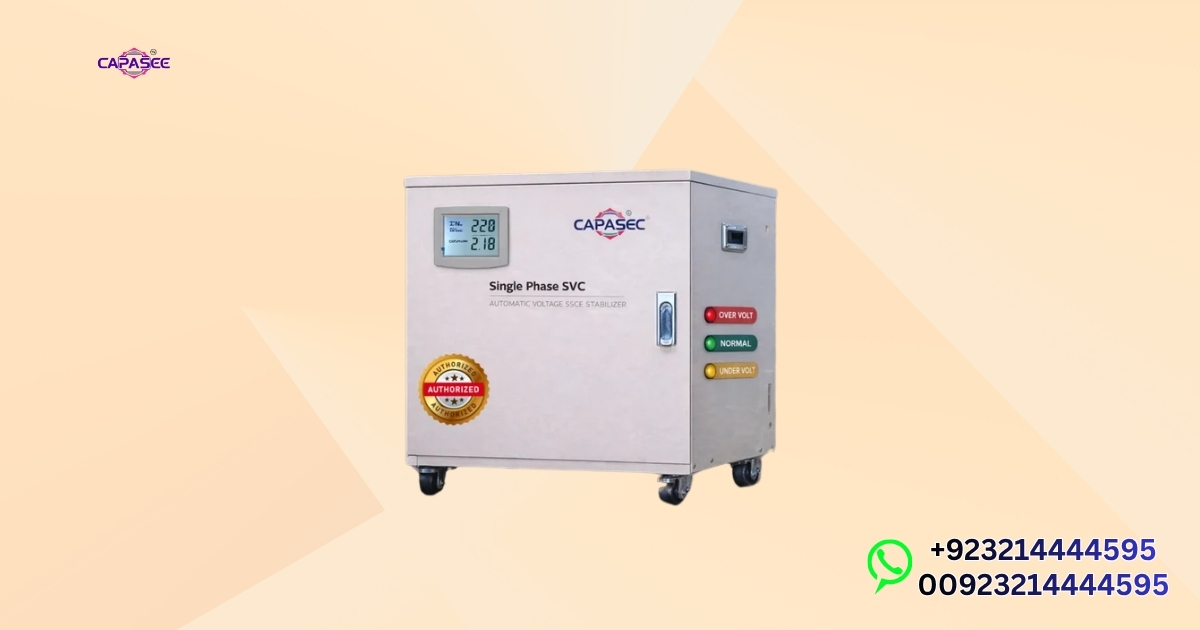
When it comes to power engineering for medical facilities, you choose a partner that will serve your needs for many years, especially when selecting a stabilizer for a CT scan machine. Capasee Electro Medical Engineering stands out in Pakistan’s healthcare industry for our expertise in power engineering and our commitment to post delivery support. We don’t just walk away once the equipment is installed; we are your power engineering partner for the life of the equipment.
We work with private diagnostic and government hospitals, and specialist imaging facilities in several provinces where a stabilizer for CT scan machine is critical. Every project we undertake deepens our comprehension of the Pakistani power market and its specific needs, the nature of grid instability, the variations in voltage during different seasons, and the problems associated with running imported CT equipment on a local power supply system.
Commitment to Reliable Medical Infrastructure in Pakistan
The diagnostic imaging industry in Pakistan is growing at a rapid pace, with new CT scan facilities being established in major and minor cities requiring a reliable stabilizer for CT scan machine. As such, the need for locally serviced and maintained solutions for reliable power will only increase. Capasee Electro Medical Engineering is at the heart of this demand, not as a vendor, but as an engineering partner who understands the importance of clinical uptime for a medical facility.
We design our stabilizers with locally sourced spare parts to avoid any service headaches, making each stabilizer for CT scan machine easy to maintain. We can service and replace every part in Pakistan, rather than waiting weeks for parts to arrive from abroad, a real benefit for all those responsible for the maintenance of these systems.
After-Sales Support and Technical Assistance for Hospitals
All Capasee stabilizers, including each stabilizer for CT scan machine, are accompanied by commissioning documentation, training for your biomedical engineers, and a guaranteed warranty period with local service availability. Our technical team is available to remotely troubleshoot and, if required, visit your site to ensure your power system remains in specification.
We know that outages of your CT scanner are not an inconvenience; they are a service disruption that impacts patient appointments, income, and reputation, which is why a stabilizer for CT scan machine is essential. That’s why our support plan is based on response, not just coverage. When you call Capasee, you will speak to a capable engineer who is familiar with the equipment and site, not an offshore call centre.
FAQ’s
Why do CT scan machines require a high-precision stabilizer?
CT scan machines house sensitive detector arrays and X-ray tubes that work within a tight voltage range. Any small variations can cause artifacts in images. A precision stabilizer for a CT scan machine delivers a stable supply of electricity to the equipment, maintaining image and equipment integrity and preventing costly damage to internal components.
What is the ideal voltage range for a CT scan machine in Pakistan?
The average CT scan machine operates on a three phase supply between 380V and 415V ±1% . In the absence of a stable voltage in Pakistan, a medical grade servo stabilizer is recommended to keep the voltage within this range. Capasee Electro Medical Engineering designs each stabilizer to your scanner’s voltage requirement.
How does voltage fluctuation affect the lifespan of X-ray and CT tubes?
The X-ray tube fires at varying kilovoltage (kV) levels due to voltage fluctuation, causing thermal stresses in the anode assembly. This reduces the lifespan of the tube to a million rupee replacement. A suitable stabilizer for CT scan machine prevents this by providing stabilized power for each scan.
Can a standard residential stabilizer work for a medical imaging machine?
No, a residential stabilizer cannot handle the large three phase loads and rapid response to voltage fluctuations required by CT imaging devices. These have slow mechanical response times and low voltage accuracy around ±10%, which is unsuitable for any medical imaging. This could result in poor scans and permanent damage.
What distinguishes medical-grade stabilizers from industrial ones?
Medical stabilizers offer better voltage regulation ±1%, cleaner waveform free from distortion, and quicker electronic response time than industrial stabilizers. They’re also designed to accommodate the inrush current CT scanners draw. Capasee designs stabilizers tailored to specific medical imaging loads, not industrial units.
How often should a stabilizer for a CT scanner undergo maintenance?
When a stabilizer is connected to a CT scanner, it should be serviced every six months. This involves checking your servo motor brushes, output voltage at full load, cleaning the contacts, and the earthing system. Capasee Electro Medical Engineering offers a maintenance program with each installation to ensure your power system runs within clinical tolerance all year long.
Conclusion
The power source is the foundation for reliable diagnostic imaging, not the patient. The right sized and installed stabilizer for CT scan machine safeguards your equipment investment, eliminates image distortion, and ensures uninterrupted operation of your facility. Such a system may seem like a small consideration, but in Pakistan’s competitive healthcare market, they impact your bottom line.
If you are still operating your CT scanner on unregulated or inadequate power protection devices, you are risking every CT scan you take. To learn more about how Capasee Electro Medical Engineering can meet your medical facility’s needs, contact us today for a technical assessment.
Your patients deserve the best diagnosis, and your equipment deserves the best power.