
Blog
Stabilizer For AC

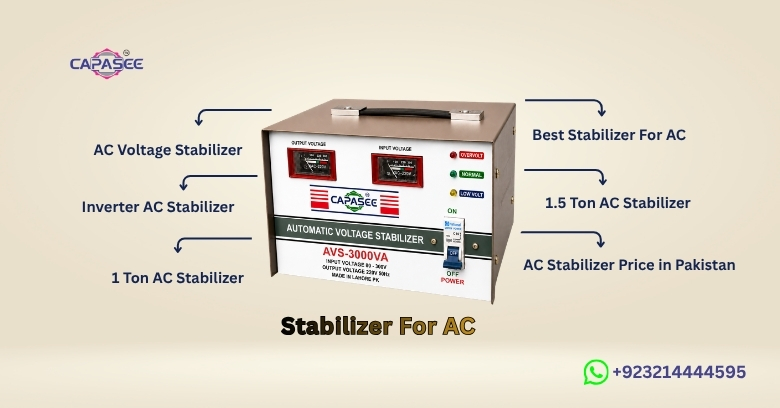
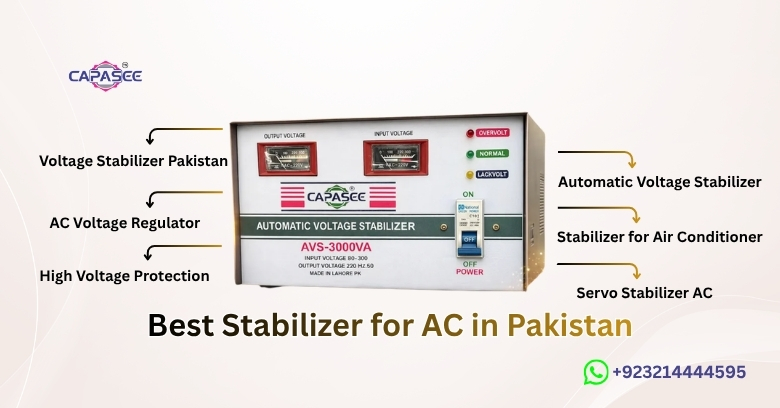
A stabilizer for AC stabilises the voltage that reaches the air conditioner so that the compressor never operates on an unduly low or high voltage. If a clinic or hospital doesn’t have one, it could experience AC failures and warm treatment rooms in Pakistan due to reduced grid voltage that is significantly lower than the nominal 220 to 230 volts. The correct one will depend on how much power you need at any given time, the type of stabilizer you have, and the quality of your power supply.
The majority of the pages on this subject are product listings geared toward the home market. This guide is written by Capasee Electro Medical Engineering, which has been in the stabilizer business for 20 years, for medical facilities on how to size a stabilizer, how to differentiate between the different types of servos and relays, and some of the pitfalls in buying a stabilizer.
You will depart with some idea of which stabilizer is suitable for your AC, how much to request, and what to look for before ordering.
Do You Need a Stabilizer for AC? Understanding Voltage Protection
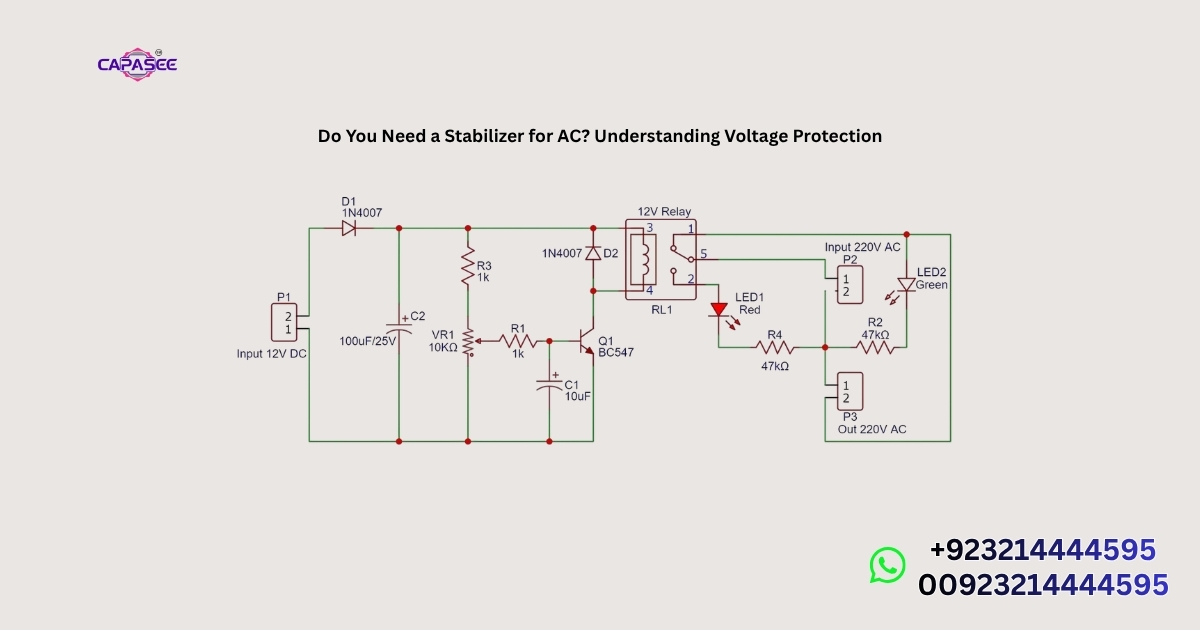
A stabilizer is required for an AC if the voltage in the AC’s manual is not met regularly. Within that range, it’s an unnecessary expense to buy a stabilizer for AC.
The grid can turn quite nominal in Pakistan. In 2013-14, NEPRA discovered consumers receiving as low as 170 volts, instead of 220 to 230 volts. Use a measurement tool to determine the level of supply rather than estimation.
Use this checklist to decide:
Find the operating voltage range in the manual or on the nameplate.
- Invite an electrician to take voltage readings at peak times for a couple of days.
- Record the number of times the reading is below or above that range.
- If it occurs frequently, use an air conditioner stabilizer. A voltage protector might suffice if it occurs infrequently.
A clinic’s AC has to be 200 volts or more, yet on a summer evening, the socket reads 185 volts. That clinic should be fixed, not protected.
Is a Stabilizer Necessary for an Inverter AC?
Not always. A large number of inverter ACs have inbuilt protection and can operate at a much higher voltage than traditional ACs, which means that for many people, they don’t require an external unit. However, the AC is only turned off when the voltage is unsafe, which is controlled only by the built in protection. Does not normalise the voltage, so if the supply is weak, the supply will keep shutting down frequently.
- Built in protection: Shuts off power if it’s unsafe; does nothing; included with the AC.
- External stabilizer: Increases or decreases the voltage and keeps the AC running; is costly and requires maintenance.
An external unit is still advantageous where:
- The voltage measured is outside the range.
- Your clinic is powered by a generator that has an unreliable output.
- Patient rooms are kept warm with repeated shut off.
What Happens to an AC When Voltage Fluctuates?
Every type of fluctuation has a different effect on the AC, and the damage is often progressive. This is important to know before selecting AC voltage fluctuation protection.
- Sustained low voltage: Compressor motor current is higher than it should be for the same performance; it runs hot and is less likely to start.
- Sustained high voltage: Electronic parts and insulation are under additional stress and get older more quickly.
- Sudden surges: A single surge, like when power is restored after a power outage, may be harmful to the control board.
The majority of ACs turn off to safeguard themselves. This preserves the compressor, but it subsequently leaves the room warm, which for a clinic is often more costly.
You can also read this blog: Voltage Stabilizer
How to Choose the Right Stabilizer Capacity for AC
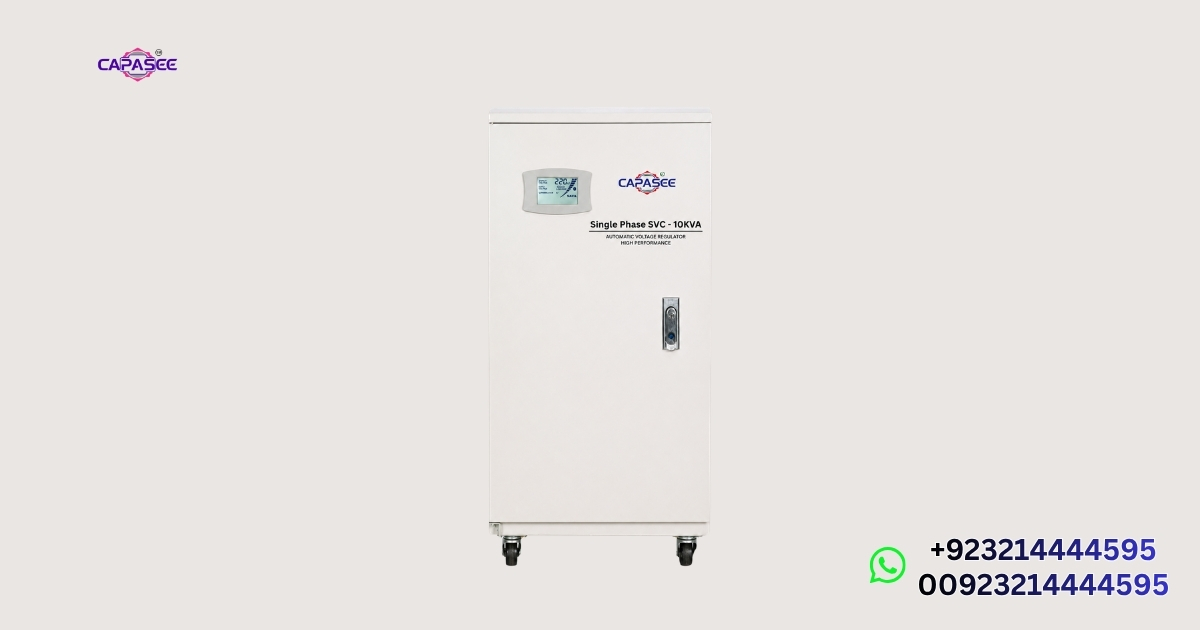
Choose a stabilizer for the AC according to the actual power draw of the AC in VA, not the tonnage label. Each 1.5 ton unit requires different power and stabilizers.
Remember the start up surge, and refer to the datasheet; it has lower output if the input voltage is low. That’s information many quick size charts don’t reveal.
What Size Stabilizer Is Required for 1 Ton, 1.5 Ton and 2 Ton ACs?
This is not a hard coded table; it’s your nameplate that determines the size. This is the table that displays what to read for a stabilizer for 1 ton, 1.5 ton and 2 ton AC.
| AC size | Read on the nameplate | Why the answer varies | How to size |
| 1 ton | Maximum input watts, rated current | Older non inverter models may draw more than newer inverter ones | Calculate VA, add margin |
| 1.5 ton | Maximum input watts, rated current | Startup draw differs between inverter and non inverter models | Calculate VA, add margin |
| 2 ton | Maximum input watts, rated current | Higher startup surge makes low voltage derating matter more | Calculate VA, add margin |
Tonnage only kVA charts are easy to look at but deceptive purchases. Please provide your nameplate information to Capasee Electro Medical Engineering, and we will help you select a unit that’s right for your load.
How to Calculate the Correct Stabilizer Capacity in VA and kVA?
Calculate the VA by dividing the maximum input watts of the AC by its power factor to get the VA of the AC, then divide by 1,000 to get the kVA of the AC. Watts indicate the amount of power used by the AC, and VA indicates the total load that the stabilizer handles. This calculation helps determine the correct stabilizer for AC capacity.
Find the maximum input power (W) or rated current (A) on the nameplate.
- Thus, VA = Watts / Power Factor, or Watts = VA x Power Factor.
- Current: VA = Voltage × Current.
- Convert: kVA = VA ÷ 1,000.
Include a safety factor and derate under low input voltages when choosing a stabilizer for AC.
Example: An AC with 1,800 W maximum input and a 0.9 power factor needs 1,800 ÷ 0.9 = 2,000 VA, or 2 kVA. As battery size is generally a standard size, the usable capacity of the stabilizer at the lowest voltage in your application will have to be greater than that, and you will typically be selecting the next standard size up.
Types of AC Voltage Stabilizers and Their Key Differences
The best suitable stabilizer for AC is determined by the type of electricity supply, the capacity of the AC, air conditioner voltage fluctuation, and protection needs. Relay, servo,, and static stabilizers are all considered for residential and commercial use in Pakistan, but each has its performance attributes.
The function of an AC voltage stabilizer is to help the electrical power it receives to deliver the appropriate output voltage to the equipment it powers. Don’t just buy it because of the price; compare its operating range, correction accuracy, response time, load capacity, and safety features before you make your purchase.
Servo, Relay and Static Stabilizers: Which Is Best for AC?
For every air conditioner, there is no one size fits all technology. Depending on their specification, a stabilizer for AC using relay technology might be the best choice for the buyer looking for a simple voltage stabilizer with economical performance, and a servo or a static stabilizer would have other regulation characteristics.
| Feature | Relay Stabilizer | Servo Stabilizer | Static Stabilizer |
| Voltage correction | Stepped | Continuous | Electronic |
| Correction mechanism | Relays and transformer taps | Motor driven variable transformer | Power electronic circuits |
| Response | Model dependent | Limited by mechanical movement | Generally fast |
| Output accuracy | Depends on design | Generally precise | Depends on design |
| Maintenance | Relay and contact inspection | Mechanical servicing | Usually lower mechanical maintenance |
| Cost | Generally economical | Varies with capacity | Often higher |
| Suitable application | Residential ACs | Continuous voltage regulation | Applications requiring fast electronic correction |
For applications that must be corrected quickly with electronic methods, the following products are recommended:
Relay stabilizers adjust the transformer taps for correct voltage whenever the input deviates from certain limits. When the capacity and input voltage of the air conditioning set are suitable, a stabilizer for AC can be used as a practical solution for home air conditioning.
A servo mechanism with a motor is employed to vary the output voltage continuously in a servo stabilizer. They may be appropriate if the voltage is subject to frequent variation and a fairly accurate regulation is necessary, but they require periodic checks of the mechanical parts.
Static stabilizers are employed instead of a motor driven correction mechanism, which is based on electronic switching and control circuits. If the product has been properly rated for the AC load, its response can be quick, and it can be considered if quick correction is desirable.
When considering a servo stabilizer for AC, a relay stabilizer for AC, or a static stabilizer for AC, a prudent strategy is to confirm the specifications with the manufacturer’s data sheets. Before choosing, consider the following features of correction. Before choosing, compare the following features of correction.
Stabilizer vs Voltage Protector vs UPS: What Is the Difference?
A stabilizer, voltage protector, and UPS have different functions in the electrical circuit. These differences can help you to buy the right protection equipment without wasting your money on a device that can’t address your specific electricity issue.
| Device | Main Function | What It Does | Best Application |
| Voltage stabilizer | Voltage regulation | Adjusts unsuitable input voltage within its operating range | AC voltage fluctuation protection |
| Voltage protector | Power disconnection | Disconnects equipment during unsafe voltage conditions | Overvoltage and undervoltage cutoff |
| UPS | Backup electricity | Supplies stored battery power during outages | Computers, networking, and backup dependent equipment |
For example, in the case of a drop in the electricity supply from 220V to 175V, a stabilizer for AC of an appropriate rating might restore the original voltage. A voltage protector is usually a device that shuts off the appliance when the voltage goes outside of its programmed safety limits.
A stabilizer can keep your AC running during periods of partial electricity loss, as experienced in load shedding events, but once the electricity is totally lost, a stabilizer will not be able to do so. It requires a UPS or equivalent backup power system, which is specifically designed to accommodate the electrical load and starting requirements of the air conditioner.
A stabilizer is not a substitute for surge protection, or a suitable voltage cut off device is one important consideration. The protection arrangement should be chosen based on the supply conditions and the manufacturer’s recommendations for the air conditioner.
How to Install and Maintain an AC Voltage Stabilizer
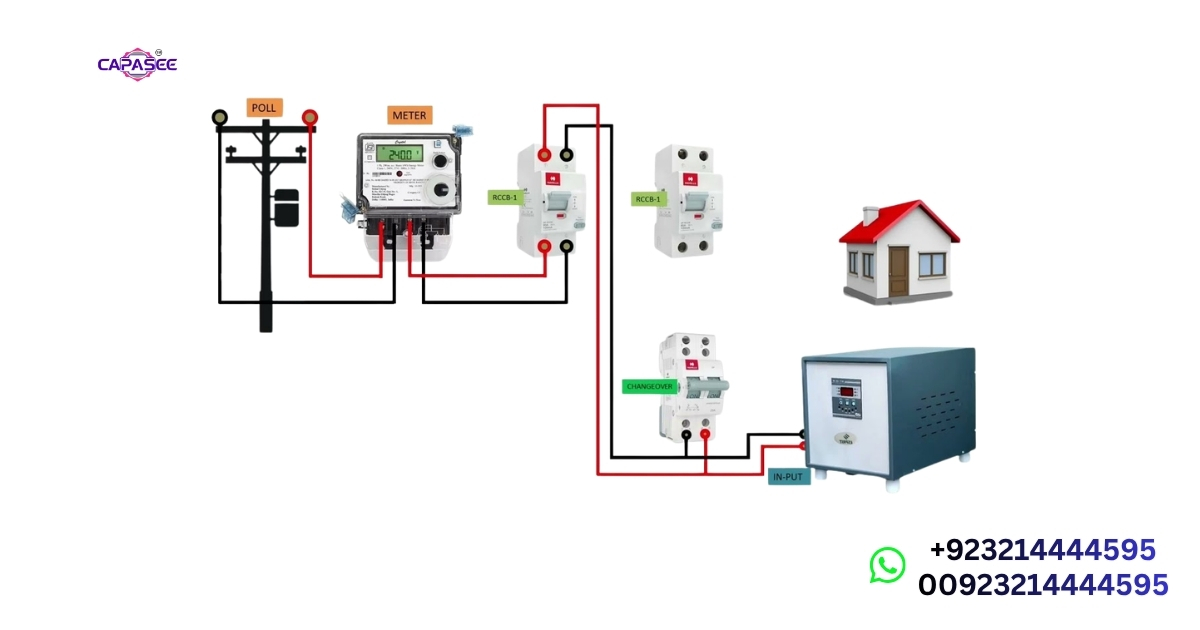
An AC voltage stabilizer is safe and reliable when installed and inspected correctly. Choose the correct size stabilizer for the AC and apply the manufacturer’s wiring guidelines; make sure that the electrical wiring is capable of operating the unit at the maximum running amperage.
In Pakistan, problems like voltage fluctuation, insufficient wiring, and overloaded electrical circuits can impact the performance of an air conditioner. A properly installed stabilizer should include appropriate earthing, adequate air circulation, appropriately rated cables, and proper circuit protection to minimize unnecessary electrical hazards.
See More & Buy: Our Products
How to Calculate the Correct AC Stabilizer Capacity?
The right AC stabilizer capacity is determined by the electrical specifications of an AC and not just on the tonnage. The type of current, rated voltage, starting capability, and the stabilizer’s efficiency with low line voltage all impact the capacity needed when selecting a stabilizer for AC.
Apply this simple formula when working out a single phase AC:
Required VA = AC running current (A) × Supply voltage (V) × Safety margin
Suppose, for example, that an AC has a rated running current of 6A and is rated for 230V. It has a rated power of 1,380 VA. A 1.4 safety margin would result in around 1,932 VA, and you should check out the next standard size available that meets the manufacturer’s starting current and low voltage specifications.
| Air Conditioner | Initial Capacity to Investigate |
| 1 ton AC | 2 to 3 kVA |
| 1.5 ton AC | 3 to 4 kVA |
| 2 ton AC | 4 to 5 kVA |
These are selection ranges and NOT universal ratings. Always check the running and starting loads and minimum input voltage, as well as manufacturer recommendations, before buying a stabilizer for AC.
Keep in mind that not all VA and watts are the same. For instance, a 2000VA stabilizer may not deliver 2000W of usable power. The actual available load depends on its rated output current and its power factor.
This calculation is very essential while choosing a stabilizer for AC for 1.5 ton AC or a stabilizer for 2 ton AC. A unit that operates within its normal voltage operating range could be overloaded if the voltage decreases considerably.
Does an Inverter AC Need an External Voltage Stabilizer?
Not all ACs with an inverter need another external stabilizer. Some newer inverter models have voltage protection that is programmed into them, but the range of input voltage they accept and the level of protection they will provide vary from manufacturer to model.
If you want to purchase an external AC power stabilizer, you should make sure that the manual of your AC specifies its operating voltage range, protection, and electrical needs. If the local supply is often outside of that range, ask a professional technician if there is a regulator that is compatible. Don’t assume that all inverter ACs are safe to run at very low voltage.
Frequently Asked Questions
What stabilizer is required for 1.5 ton AC?
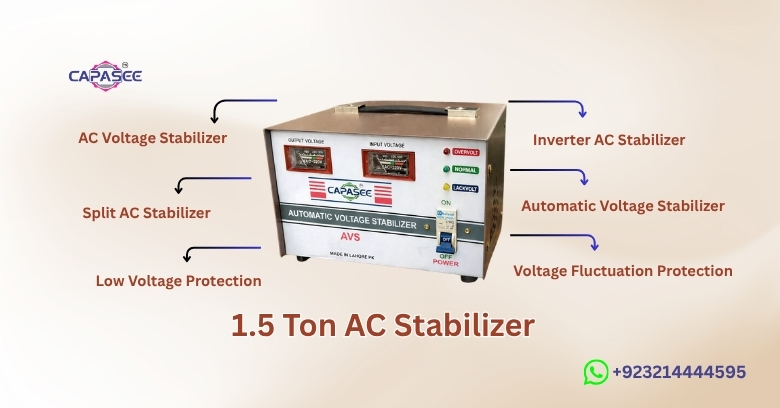
A 3 to 4 kVA stabilizer is a first line of defence, but first look at your AC’s rated current and starting requirements.
Which stabilizer is the best for AC?
The most suitable stabilizer for an AC is best chosen to meet the following requirements; Voltage fluctuation, operating range, correction accuracy, compressor requirements, and budget.
What is the need of a stabilizer in AC?
The AC stabilizer ensures the correct voltage in case of voltage fluctuations, thus minimizing the chances of damage to equipment due to voltage fluctuations.
What is the price of a 1.5 ton AC stabilizer in Pakistan?
The price depends on the capacity, technology, winding material, and protection features; please ask Capasee Electro Medical Engineering for the latest quote.
Do I need a voltage stabilizer for my AC?
If your electricity supply is often outside of the recommended operating voltage range for your AC manufacturer, then you need one.
Do Inverter ACs need a stabilizer?
Not necessarily, since many inverter ACs are voltage protected; however, in poor supply conditions, some external voltage protection might be required.ns.
What size (kVA) stabilizer do I need?
Choose a stabilizer according to the rated current, voltage, and starting requirements of the AC, as well as the minimum input voltage.
Relay based vs. Servo Stabilizer: What is the difference?
Relay stabilizers function in step voltage control, and servo stabilizers use motor mechanisms to continuously adjust the voltage.
Stabilizer vs. Voltage Protector: Which is better?
A stabilizer regulates voltage, while a voltage protector will cut off electricity in unsafe circumstances, so you need to choose between them.
Conclusion
The first step in selecting the correct stabilizer for AC is to know your AC’s actual electrical requirements and conditions in your area. Before buying, keep in mind three key factors:
- Capacity: The stabilizer’s kVA rating should be compatible with that of your AC and its starting requirement.
- Technology: Identify relay, servo, and static stabilizers based on your budget and voltage regulation requirements.
- Protection: Operating range, overload protection, voltage cut off, warranty.
Compare products on their specifications before buying them; do not compare them solely on the price. For more information on the product, technical guidance, and an updated quotation, please contact Capasee Electro Medical Engineering to get a suitable stabilizer for AC.