
Blog
UPS for Hospitals

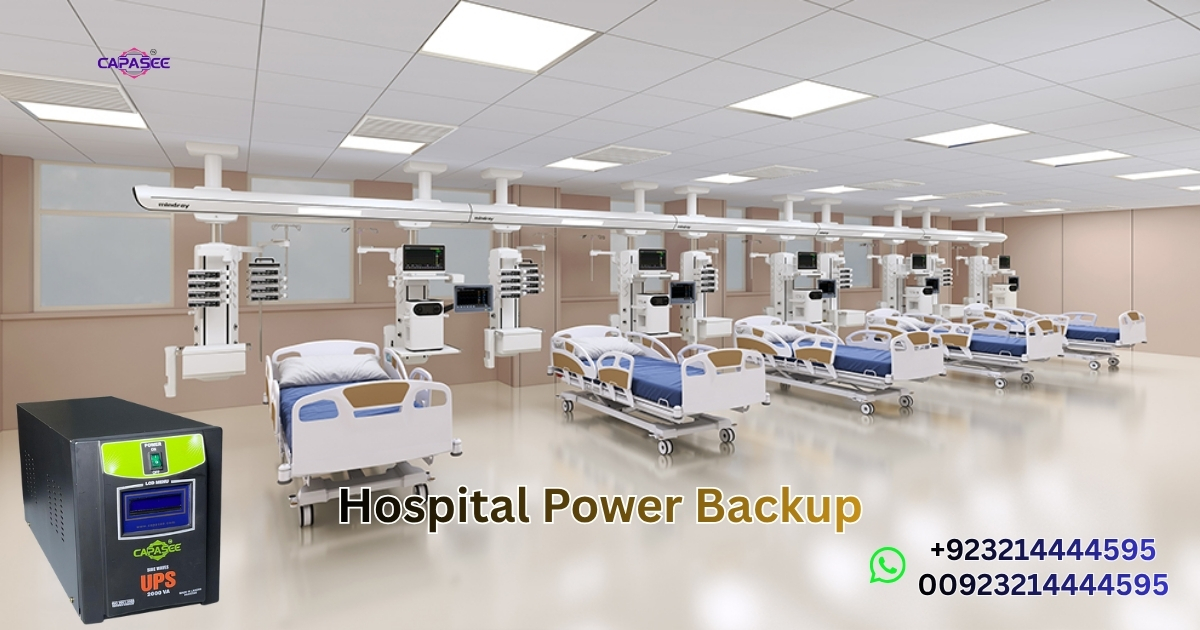
An individual power failure in a hospital setting has resulted in death. Ventilators stop. Surgical lights turn off. ICU monitors go off. This is not a scenario one can imagine in facilities in Pakistan where grid instability is a daily occurrence. It happens. That’s why UPS for hospitals is not a purchase decision; it’s a patient safety decision.
But the majority of hospital administrators don’t invest in backup power or select power supplies designed for offices, not operating theatres. The result? Damage to equipment, loss of data, and in the extreme case, permanent medical emergencies.
Capasee Electro Medical Engineering has simplified the understanding of everything from how hospital grade UPS for hospitals systems works to what matters for your specifications to how the right partner in Pakistan can make a huge difference.
Why Hospitals in Pakistan Need a UPS for Hospitals
Hospitals are not like offices. From a ventilator to an infusion pump, everything that is connected has a life on the other end. Power outages, even briefly, can have devastating effects. Hospitals have only one vital investment they need to make, and that is a reliable UPS for hospitals.
This is all the more important in the context of Pakistan’s energy situation. In big cities like Lahore, Karachi and Peshawar, load shedding is a common occurrence and sometimes takes up as much as 8 to 12 hours during the summer months. Every day, hospitals run on borrowed time if they do not have a backup power system appropriately rated for their needs. A dependable UPS for hospitals helps ensure continuity of care.
Life Saving Equipment That Requires Zero Downtime
Laptop computers and other critical medical equipment cannot afford to lose any power. Clean uninterrupted power is a requirement for ventilators, cardiac monitors, anesthesia machines, surgical lighting systems and other equipment supported by UPS for hospitals.
Let’s look at a true case; when a patient’s cardiac monitor restarts during a cardiac surgery. The 3 second delay can make all the difference. Power protection like this requires instant power protection and is not reactive. This is why UPS for hospitals remains essential.
Power Outages and Voltage Fluctuations in Pakistan’s Healthcare Sector
The voltage level in the national grid is not consistent, with sometimes the voltage level rising to 180V and at other times dropping to 250V in the same hour in Pakistan. This isn’t a hassle. Is a deliberate degrader of sensitive medical electronics over time. Proper UPS for hospitals can reduce this risk.
In public sector hospitals of Punjab and Sindh, equipment failure has been reported due to the direct cause of unstable electric power. Early investment in power backup systems for medical use has saved private hospitals thousands of rupees in repair bills and, most importantly, saved lives. Modern UPS for hospitals plays a key role in this protection.
You May Also Read This Blog: Industrial UPS for Manufacturing Units in Karachi and Lahore
Types of UPS for Hospitals: Choosing the Right System

All UPSs are not created equal. Depending on the type of system you employ, your hospital could either stay up and running during a blackout or go down when you need it the most. If you understand the various possibilities, you can make the right decision.
There are three main categories of UPS that hospitals should consider; online UPS, offline UPS and medical grade UPS. These each have a different purpose and different benefits depending on the deployment location in a facility. Selecting the right UPS for hospitals is critical.
Online UPS vs Offline UPS for Medical Facilities
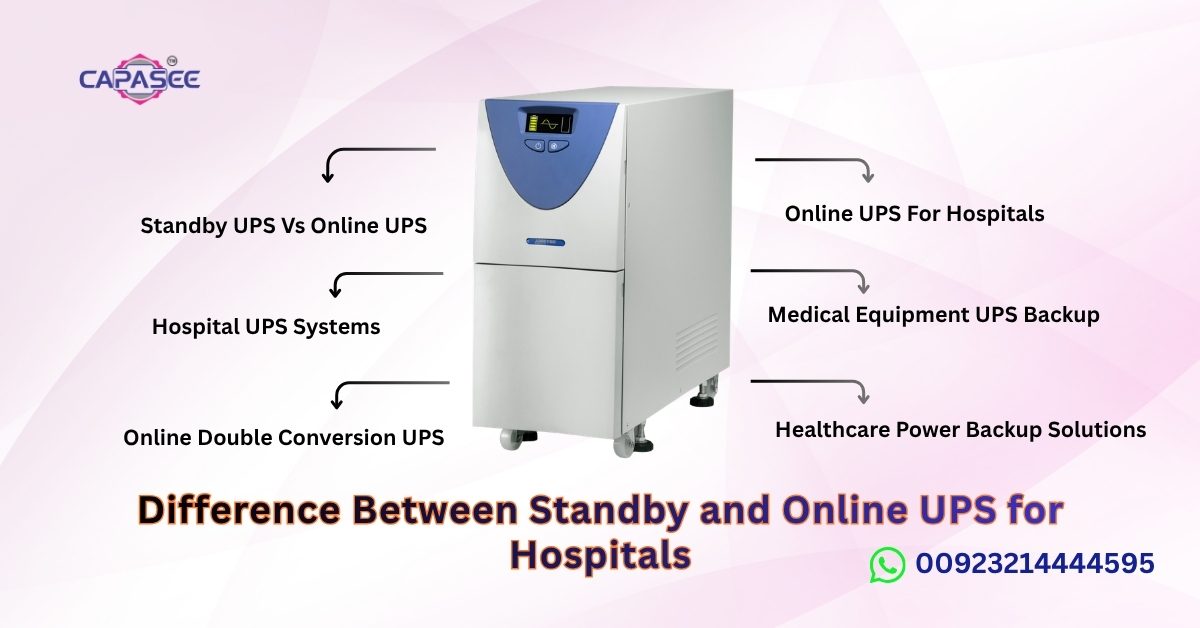
An online UPS will always convert the AC power to DC and back to AC so that your equipment never gets direct AC voltage from the grid. The outcome is no transfer time during outages. An offline UPS, on the other hand, activates the battery power when it detects a power outage, creating a 5 to 10 millisecond delay.
An offline UPS is sufficient for administrative computers, billing systems or office computers. However, the only online UPS that’s acceptable is one that’s related to a patient. It’s not just a technical distinction. It is clinical. For patient care, UPS for hospitals should always meet medical requirements.
Medical Grade UPS Systems for Critical Hospital Equipment
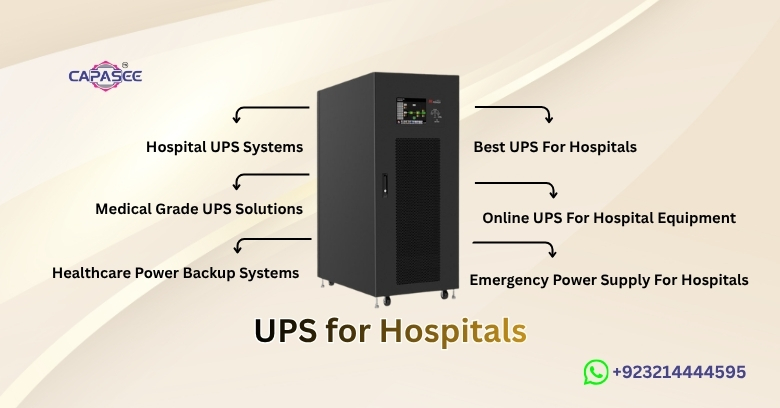
Medical grade UPS for hospital systems are more than simply power backup systems. These include higher levels of advanced EMI filtering, isolation transformers, and more stringent control of leakage currents that help safeguard patients and equipment.
There is a lot of electrical noise emitted and absorbed by devices such as CT scanners, MRI machines, X ray units and neonatal incubators. That noise can not be effectively filtered by a standard commercial UPS. All of this is taken care of by a medical grade system with the right specifications and installation. This makes UPS for hospitals a necessity.
The following is a comparison of UPS types for hospitals.
| UPS Type | Downtime | Best For | Voltage Protection |
| Online UPS | 0 ms | ICUs, Ventilators, Operation Theaters | Full |
| Offline UPS | 5 to 10 ms | Non critical IT Admin Workstations | Basic |
| Medical Grade UPS | 0 ms | CT Scan, MRI, X-ray, Neonatal Units | Advanced + Filtering |
Key Benefits of Installing UPS for Hospitals in Pakistan
The proper backup power system will not only keep the lights on; it will provide other benefits as well. It safeguards your investment, your patients and your hospital’s reputation. Medical facilities in Pakistan that have enhanced their electrical systems claim that their equipment’s life is increased and their operational uptime is enhanced through UPS for hospitals.
A hospital UPS system provides confidence to your clinical staff, in addition to hardware protection. If the surgeon is aware that the theatre will not be switched off during the operation, he/she will operate with focus. The certainty is real value. This is one of the greatest benefits of UPS for hospitals.
Protection Against Data Loss and Equipment Damage
Data is the lifeblood of modern hospitals. Data from EHRs, diagnostic imaging, and laboratory tests is stored on servers that are susceptible to power outages. Data stored in electronic health records, diagnostic imaging and laboratory tests reside on servers that can be affected by unexpected power outages. Properly dimensioned and sized UPS for hospitals with adequate runtime will allow systems to shut down properly, or better, fail safely without a single issue.
One of the most overlooked expenses in hospitals in Pakistan is equipment damage caused by power surges. The one voltage spike can destroy an ultrasound machine with several crores of value. A good UPS for hospitals will pay for itself the first time that it prevents it.
Compliance with Healthcare Safety Standards and Regulations
Power backup requirements for licensed medical facilities are now mentioned a number of times in Pakistan’s healthcare regulatory system, such as in the guidelines issued by DRAP and the provincial health authorities. Hospitals applying to be accredited by the Joint Commission International Accreditation and the ISO certification must show reliable power protection through UPS for hospitals.
A hospital grade UPS for hospitals is not only an astute operational choice; it is an essential one. It’s moving toward being a compliance mandate. Installing this investment is vital for facilities that fail to do so or lose their licences and are facing reputational challenges that can take years to recover.
Check More & Purchase: Our Products
How to Choose the Best UPS for Hospitals from Capasee Electro Medical Engineering

The first step in picking the best UPS for hospitals for your hospital is to discover the correct power demands of your facility and not just guess. Capasee Electro Medical Engineering collaborates with hospital administrators, biomedical engineers, and facility managers throughout Pakistan in order to correctly size, specify, and implement systems that are likely to match real clinical settings.
It is not only the product that is sold at Capasee. It includes a complete power audit, a load calculation and post installation support to ensure your UPS for hospitals system continues to operate efficiently year after year.
Calculating UPS Capacity for Your Hospital’s Power Needs
Begin by making a list of all critical loads in your facility. The wattage or VA (volt ampere) rating is printed on the label of each device or on the manual. Include those numbers, then multiply by 1.25 to allow for a safety margin. The last number represents the lowest capacity of UPS for hospitals.
A 20 bed ICU with ventilators, monitors, infusion pumps and lighting generally requires a UPS for hospitals ranging in size from 20kVA to 40kVA. Larger facilities or facilities that have imaging departments will require much greater capacity, which can be as large as 100 kVA or larger.
Capasee Hospital Grade UPS Solutions and Custom Support
Capasee Electro Medical Engineering provided and installed medical grade UPS for hospitals which are specially designed for the medical sector in Pakistan. All solutions are customized to your hospital’s load, physical configuration and budget; there is no guesswork involved.
Capasee provides comprehensive power protection system management from initial site assessment to annual maintenance contracts. Their biomedical and electrical engineering group has an intimate knowledge of all technical and regulatory needs of hospitals in Pakistan; hence, they are a trusted partner of hospitals ranging from small clinics to multi speciality hospitals using UPS for hospitals.
Frequently Asked Questions
What is UPS in a hospital?
A backup power device that is installed in a hospital to provide immediate power back up to critical medical equipment when the primary power is lost is referred to as a UPS in a hospital.
What does UPS stand for in healthcare?
In healthcare, an uninterruptible power supply (UPS). It guarantees an uninterrupted power supply to the life critical equipment during an outage or voltage fluctuation.
How much does the UPS system cost in Pakistan?
The price of UPS units in Pakistan ranges from PKR 50,000 for small units to PKR 2,000,000 or even higher for hospital grade medical installations.
What is medical UPS?
A medical UPS is a medical power backup system that is equipped with isolation transformers and leakage current control to ensure the safe protection of patients and sensitive medical equipment.
What is a UPS full form?
The full form of UPS is Uninterruptible Power Supply. An electrical piece of equipment that supplies immediate power in the event of a loss or drop in the main electrical power.
What are three types of UPS?
Offline UPS, line interactive UPS and online UPS are the three types of UPS. Online UPS is the most suitable solution for hospitals and has zero transfer time.
What do UPS stand for?
UPS is an acronym for Uninterruptible Power Supply. Provides uninterrupted, clean electricity to connected devices when the power goes out or when there’s a voltage fluctuation.
What are the 4 components of UPS?
There are 4 major components in the UPS; Rectifier, Battery, Inverter, Static Bypass Switch. Combined, they provide a continuous and clean supply of power to connected equipment.
Conclusion
Protecting your hospital’s critical equipment begins with just one simple decision; make power backup a mandatory part of your hospital’s critical equipment. The right UPS for hospitals ensures your patient’s ventilators keep running, protects patient data, and helps keep clinical staff working without fear of outages or voltage damage. Your hospital’s internal power quality can stabilize, but Pakistan’s power grid will not.
Use what you’ve learnt here. Measure the load, select the appropriate system, and spend money on infrastructure that is able to defend patients and gear.
Call Capasee Electro Medical Engineering today to get a free site assessment and a custom power solution designed to fit your facility’s needs.
Your patients deserve a hospital without the inconvenience of outages at the wrong time.