

Blog
How to Choose the Right UPS for Laboratory Equipment

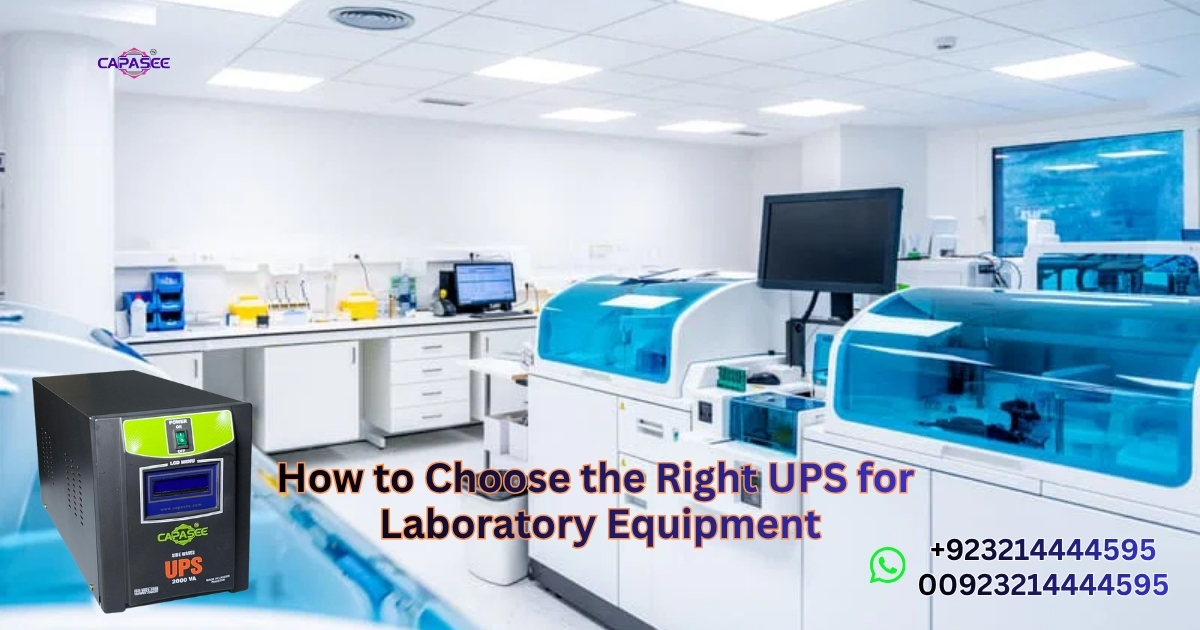
Most lab managers in Pakistan still consider the selection of UPS as an afterthought, despite the fact that a power failure of only 90 seconds can put weeks of continuous lab work at risk. You have already felt the impact of the wrong power backup solution when a critical sample is lost, a data run is corrupted, or a centrifuge has come to a halt mid cycle due to load shedding. In this context, how to choose the right UPS becomes a critical decision rather than a secondary consideration.
The energy scenario in Pakistan also has significance here, which is not present in the less volatile energy grids. The unpredictability of load shedding in the provinces of Punjab, Sindh and KPK means that selecting the correct UPS for particular lab equipment is not only a good practice but also a crucial step to safeguard the equipment, data and budget. Understanding how to choose the right UPS in such conditions helps avoid costly downtime and equipment failure.
Capasee Electro Medical Engineering guides you through all the considerations; how much load, UPS topology, how long the batteries will last, waveform compatibility and much more, so you can make an informed purchase decision with confidence. This practical approach reflects how to choose the right UPS for laboratory environments where precision and continuity matter.
Understand Your Laboratory’s Power Needs

This is an important step to take when buying something to make sure you don’t have to deal with the consequences of a bad choice. Each lab is different, and the first step in the process of selecting an appropriate UPS is understanding how much power your devices require and what type of protection they require. This is the most frequent mistake that lab managers in Pakistan make when they purchase a UPS; they skip this step. Learning how to choose the right UPS always begins with accurate load assessment.
This happened to a Lahore based diagnostic lab that installed a basic 1000VA UPS on their haematology analyzer, but found that the analyzer’s startup surge caused the UPS to blow out. The numbers never lie, so Capasee Electro Medical Engineering has a routine of helping clients re evaluate their equipment list before any purchasing decision is made.
Calculate Total Wattage and VA Requirements for Lab Devices
List all of the devices that will be plugged into the UPS, and include the wattage on the label or in the manual. Total up all the wattages and divide by 0.8 (standard power factor to determine minimum VA required).
For instance, if your laboratory is using a spectrophotometer at 200W, a centrifuge at 400W, and the computer workstation at 300W, your total load is 900W. If you divide 1125 by 0.8, you get 1125 VA as your minimum requirement, and thus you should buy a UPS with a rating of 1500 VA or more to provide a safety margin of 25% or more.
Identify Sensitive Equipment That Needs Pure Sine Wave Protection
Not all laboratory pieces of equipment are the same and will respond differently to the backup power. Pure sine wave output is required for variable speed motors, microprocessors, and precision sensors, including PCR machines, incubators, analytical balances, etc., to prevent damage or data errors. This is an essential part of how to choose the right UPS for sensitive laboratory systems.
Many low quality UPSs output a synthetic or stepped sine wave, which works fine for most simple computers but may generate motor humming, motor overheating, or even damage some lab equipment. We always advise you to check the output waveform specification when ordering the capacity of any equipment over PKR 200,000 at Capasee Electro Medical Engineering.
You May Also Read This Blog: UPS for Hospitals
Match UPS Type and Features to Lab Criticality
The type of UPS is not a choice of the highest cost of any UPS on the market. It’s more about the degree of protection that is required, depending on the criticality and sensitivity of every device you have in your lab configuration. Knowing how to choose the right UPS ensures the correct balance between cost and protection.
Line interactive UPS units are suitable for typical instruments that can withstand a short outage for 2 to 4 milliseconds. Online double conversion UPS systems, however, deliver zero transfer time and completely isolated, clean power and are the most suitable for high value and life critical lab equipment.
Choose Between Line Interactive vs. Online Double Conversion UPS
A line interactive UPS protects from minor voltage changes by means of an automatic voltage regulator (AVR). While the grid fails, it charges the batteries. It is an inexpensive option for pH meters, label printers, and simple microscopes.
An online double conversion UPS continuously converts AC to DC and back to AC, which means that the equipment never operates on line power. This type of power powers every connected device with clean, regulated electricity at all times, making it the ideal type of power for sensitive analytical instruments. This distinction is central to how to choose the right UPS effectively.
When to Use Online UPS for GC/MS, Electron Microscopes, and Incubators
In other types of equipment, like gas chromatographs, mass spectrometers, electron microscopes and CO₂ incubators, a half cycle loss of power could destroy an active sample run entirely or completely throw off calibration. An online double conversion UPS is a must for these devices.
Even if your lab requires incubation cycles to go on for 24 hours or overnight GC/MS sequences, the cost of losing a batch or needing a recalibration due to downtime is likely to be higher than the initial expense of purchasing a line interactive UPS versus an online UPS. Capasee offers and implements online UPS systems specially designed for laboratory applications in Pakistan.
Compare Battery Runtime, Recharge Time, and Maintenance Needs
Battery runtime is the length of time the equipment runs when it is cut off from the electric grid, and recharge time is how quickly the power comes back when your equipment, like the pump, is connected to the electric grid after a long outage. Both are important in the load shedding situation in Pakistan and influence how to choose the right UPS effectively.
Use the following table for a clear comparison to help make the decision for the type of UPS you can use for your lab’s operational needs.
| Factor | Line Interactive UPS | Online Double Conversion UPS |
| Power Protection | Good for minor voltage fluctuations | Zero transfer time, fully clean power |
| Best For | Standard lab instruments | Critical equipment (GC/MS, microscopes, incubators) |
| Cost | Lower upfront cost | Higher upfront investment |
| Recharge Time | 6 to 10 hours | 4 to 6 hours |
| Maintenance | Battery replacement every 2 to 3 years | Battery checks plus regular firmware updates |
When considering these factors, also enquire with your supplier about “hot swap” battery options. Labs with continuous processes simply can’t afford to take any time out for routine battery changes, and several online UPS models now allow for battery changes without the need to shut down the UPS. Mastering how to choose the right UPS ensures long term stability, safety, and efficiency in laboratory operations.
Check More & Purchase: Our Products
Select a UPS That Fits Pakistan’s Power Conditions

Most buying guides for UPSes are from abroad and do not take into account the challenges faced by Pakistan’s power grid when considering how to choose the right UPS. If you are not taking into account the conditions in the Pakistani grid, you might end up with a UPS that is capable of coping with textbook power issues but not real world issues in Pakistan.
The labs are experiencing a mix of frequent outages, deep voltage sags, high frequency switching transients, and load shedding, which can last from 4 hours to 10 hours in some areas of Lahore or in commercial areas of Karachi. A UPS used in these applications requires a large input voltage tolerance, good AVR performance, and a battery bank with a large capacity for extended operating times, which is an important factor in how to choose the right UPS.
Handle Frequent Grid Outages and Voltage Swings in Lahore and Punjab
Labs with LESCO or FESCO feeders often experience voltage drops and surges, from as low as 170v to as high as 250v in the Punjab area, when learning how to choose the right UPS. A UPS that can only be powered by a narrow range of input voltage (200V to 240V) will switch to battery too frequently, causing the battery to run out of juice quickly and reducing the service life.
Before it goes to battery mode, make sure to search for a UPS that has a wide range of input voltage, such as 140V to 260V. Capasee Electro Medical Engineering always emphasizes this single specification as a must have for all lab UPS installations in Punjab in areas where unstable grids are present, which can increase the battery life by up to 40%, an essential consideration in how to choose the right UPS.
Ensure UPS Supports 220V/50Hz and Works with Local Inverters
The power standard in Pakistan is 220V/50Hz, and the UPS you buy should be certified or specified for this power standard when understanding how to choose the right UPS. Units from a 120V/60Hz market will cause damage to the UPS if they are not configured and used in the proper manner and will also damage lab equipment if connected to the UPS.
Many labs in Pakistan also have a local inverter as a major supplementary backup power system in addition to a UPS. In this arrangement, the UPS mustn’t be disturbed when receiving inverter power, as the power from the inverter may be less stable than the power received from the grid, while considering how to choose the right UPS. Before recommending a UPS model, Capasee Electro Medical Engineering analyzes the power setup configuration of every lab and fully matches all the layers of power backups already installed.
Frequently Asked Questions
How to pick the correct UPS?
To select the appropriate UPS, determine the total wattage of all equipment, include a 25% headroom, and then select the UPS type for the level of sensitivity of the equipment. Online double conversion UPS with pure sine wave output are required for critical lab equipment. Capasee Electro Medical Engineering can assist you in choosing the right model for your laboratory setup.
How long will a 1000VA 600W UPS last?
A 1000VA 600W UPS typically lasts 10 to 20 minutes at a full 600W load. With fewer devices, the run time is greatly increased. Actual backup time is influenced by battery age, temperature and load percentage. When buying, always refer to the manufacturer’s runtime chart for the particular load.
How do I calculate what size UPS I need?
Add up the watts of all devices you’re protecting, then divide by 0.8 to obtain the VA rating you need. Always purchase 25% more than the minimum. A 900W load would need at least a 1125VA UPS, and it is advisable to use a UPS of at least 1500VA.
What to consider when choosing a UPS?
The load capacity, output waveform (pure sine wave or simulated), battery run time, input voltage tolerance, recharge time, and local grid compatibility are factors to take into account when selecting a UPS. The two most important features to consider when deciding to buy a laboratory for a Pakistani lab are a wide input voltage range and load shedding runtime.
Which type of UPS is best?
A double conversion online UPS is the most suitable type for laboratory applications, where there is zero transfer time, and the output is completely clean at all times. Line interactive UPS units utilizes less sensitive instruments. A double conversion can be used safely for any high value instrument, such as a GC/MS system or an electron microscope.
How long can a 2.5 kVA UPS last?
A 2.5 kVA UPS with a 50% load (approx. 1000 W) can usually provide a 20 to 40 minute battery life. The runtime is dependent on the battery capacity, load size and battery health. This may be sufficient for the lab in remote areas that experience longer power outages, such as Lahore or Faisalabad, but it can be extended to several hours with external battery packs.
Final Thoughts
There are three key aspects to consider when selecting the appropriate UPS for lab equipment; understanding the actual power load, understanding the type of UPS required to support the sensitive power equipment, and understanding the specific nature of the Pakistani electric grid, such as voltage swings and lengthy periods of load shedding, are all essential in how to choose the right UPS.
Labs using this approach safeguard their instruments, data, samples, and operations. Repairs and downtime for a wrong UPS decision will cost much more than the cost of the UPS in the first place, which is why choosing the right UPS is critical for every facility.
If you are looking for the right UPS without having to think about every specification twice, you are on the right track to getting the right UPS with the Capasee Electro Medical Engineering team while learning how to choose the right UPS. Call us now for a no cost load assessment and a knowledgeable recommendation specific to your lab.
You don’t want to leave your equipment to the wrong back up power.