
Blog
How to Choose Stabilizer for Home, Office & Hospital in Pakistan

It may come as a surprise, but voltage fluctuation causes more damage to electronics in Pakistan than any other problem, and it is done in silence, well before it sparks or burns out. If you’ve ever had a refrigerator compressor fail prematurely, or an office workstation or a hospital UPS behave erratically or crash without warning, it was probably because of an unstable power supply. You can save yourself the time and expense of soft product failures by knowing how to choose stabilizer that is suitable for your load, environment and budget.
The quality of the grid is inconsistent in Pakistan, even from industrial areas in Lahore to commercial blocks in Karachi and rural clinic setups, so choosing stabilizers is not a luxury but a necessity. In this guide, Capasee Electro Medical Engineering takes you through all factors that count, from load calculation to stabilizer types, to the extent of voltage range and specific requirements for homes, offices and hospitals in Pakistan.
How to choose stabilizer for Home in Pakistan
The first question to ask when deciding on a stabilizer for your home is whether you’re keeping a single appliance safe or your entire house safe. Once you know what you need, you can find out the type, amount, and price that will fit into your budget. Pakistan’s household power supply is constantly volatile, ranging from 170V to 250V, and if you are using appliances without protection, you are at risk of using them when they are not. Understanding how to choose stabilizer options correctly can help avoid these issues.
At Capasee Electro Medical Engineering, you have homeowners who have lost their refrigerators, inverter ACs, LED TVs, and other electrical appliances due to a single incident of a voltage spike throughout Punjab, Sindh, and KPK. The right stabilizer not only ensures the protection of equipment but also increases the lifespan of appliances by 30 to 40 per cent in areas with high fluctuations in power. This is why learning how to choose stabilizer solutions is important for homeowners.
How to choose stabilizer for Full Home Load
If the stabilizer is intended for complete household protection, then it is necessary to have a stabilizer of such capability that it is enough to operate all the household appliances at the same time. Calculate the total wattage for all items used at peak load times and then add 20% safety margin to this. This step is essential when considering how to choose stabilizer capacity.
The general size requirement of a 2-ton AC, 1 ton AC refrigerator, washing machine, lighting, etc., in a Lahore household is a 5-kVA to 8-kVA servo stabilizer on the main line. The most frequently made mistake and the most expensive mistake is undersizing.
How to choose stabilizer for AC, Fridge and TV
The variable-speed compressors in inverter ACs are particularly sensitive to voltage fluctuations, as they do not operate optimally when the input fluctuates. The safest method of protecting individual appliances is with a dedicated single-phase stabilizer of between 2 kVA and 3 kVA per appliance.
Stabilizers with a low voltage cut-off are necessary for refrigerators, and compressors are most susceptible to damage when the voltage falls below 180V. For TV and home cinema, a relay-type or servo stabilizer 500VA to 1KVA works fine and is cost-effective.
You May Also Read This Blog: Stabilizer Price 20kva Pakistan
Full Home Load vs Single Appliance Load
The difference between a main line stabilizer and a single appliance stabilizer is that one stabilizer offers protection to all devices in your home, while the single appliance stabilizer provides protection to one device at a time. The cost is higher, but they provide greater value over time to homes with multiple sensitive appliances for the main line units.
Main Line Stabilizer for a Whole House
The whole-house servo stabilizer is to be fitted by a licensed electrician at the distribution board. At Capasee, we recommend using servo-type units throughout the house, as they can provide continuous voltage correction as opposed to the stepped correction that relay-type units can provide.
How to choose stabilizer for Office in Pakistan
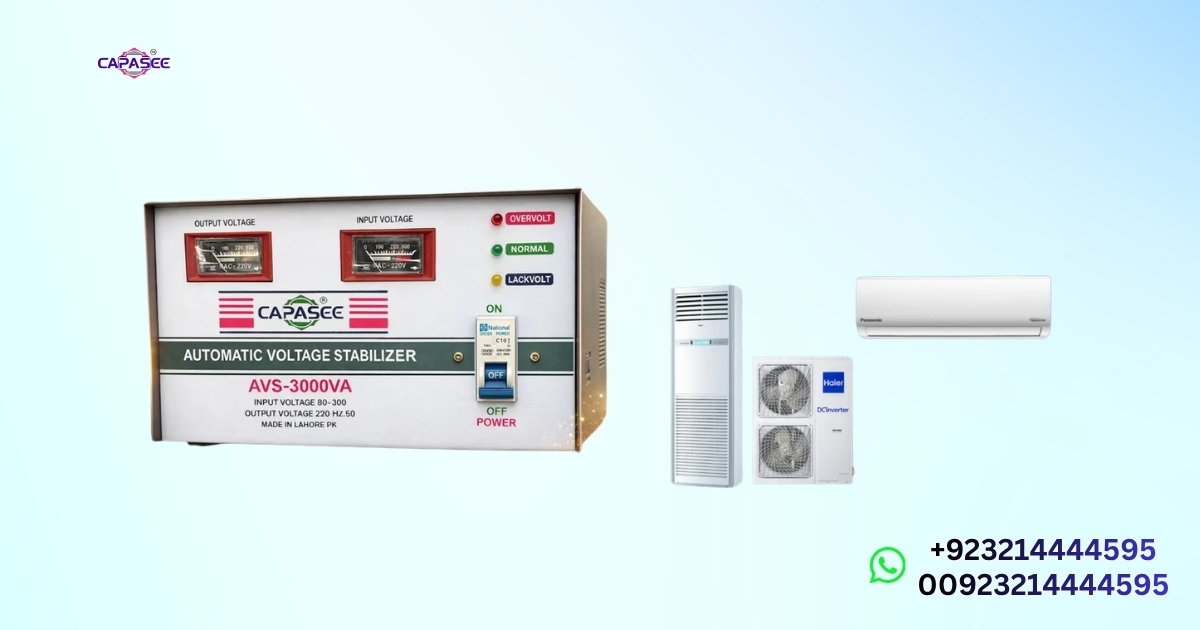
There are different types of risks in an office than in a house. That’s because voltage dips can cause data to be corrupted, servers to go down, and expensive networking components to be ruined. The correct stabilizer for an office will rely on the type of equipment you’re operating, as well as the overall connected load. Knowing how to choose stabilizer systems for office equipment can reduce these risks.
A three phase stabilizer or split single phase stabilizer system for 10 work stations, two printers, and a CCTV system, typically required for a small office in Karachi, is from 5 kVA to 10 kVA. This calculation can be incorrect, depleting your finances or exposing your equipment.
How to choose stabilizer for Computers and Networking
The most stable voltage output possible is required by computers and networking equipment. A short time of operation at a voltage higher or lower than the rated input range of the router, managed switch or NAS device can lead to damage or data loss, which cannot always be recovered by a backup system.
An automatic voltage regulator (AVR) with a close output tolerance of plus or minus 1% is recommended for setups of ten computers with networking equipment. Capasee Electro Medical Engineering offers AVR units, which are engineered for use in environments where output stability is paramount, and they are therefore specifically used for IT loads. This is another important factor in how to choose stabilizer equipment for professional environments.
How to choose stabilizer for an Office Main Line
The main line protection is paramount and will need to consider all of the power-consuming devices that are used at the same time, such as the air conditioning, lights, security system and all IT equipment. The best solution for medium- to large-sized offices is a three-phase servo stabilizer at the main distribution board.
A single-phase automatic stabilizer in the 5 kVA range is adequate and much more cost-effective for smaller offices less than 2,000 square feet and for lower equipment loads. Always make sure to size up 15% higher than needed in case of equipment additions. Proper sizing is a key part of how to choose stabilizer systems for offices.
Best Stabilizer for Office Equipment
Servo stabilizers equipped with microprocessor-controlled correction circuits are ideal for office use due to their ability to cope with both slow drift and sudden surges. The most affordable stabilizers are of the relay type, but they correct in steps that are too severe for sensitive digital devices.
Voltage Needs for Printers, Servers and CCTV
When your stabilizer is undersized, a high current is drawn by the laser printers during warm-up, causing a momentary voltage drop. Rock-solid 220V output is essential from a server at all times, and a CCTV system with faulty power supplies will cause frame drops and gaps in recording, thus negating the purpose of the CCTV system.
How to choose stabilizer for Hospital in Pakistan
Hospitals have a different set of standards than homes or offices. Medical devices are life-critical; a voltage fluctuation that simply restarts a computer may trigger a patient monitor, infusion pump or ventilator at a crucial time. Choosing an appropriate stabilizer in a hospital is not only an engineering decision; it is a patient safety decision! Understanding how to choose stabilizer solutions for healthcare environments is therefore essential.
We have delivered and installed stabilizer systems in clinical environments in Pakistan, and the most frequent issue we encounter is when patients homes are using residential stabilizers in clinical environments. That is too much of a risk. Proper knowledge of how to choose stabilizer units helps avoid such critical mistakes.
How to choose stabilizer for Medical Devices
For medical devices, the required output voltage tolerance is as low as ±1% or less. While the standard commercial stabilizer can deal with tolerances of plus or minus 5%, this is too high for equipment such as ECG machines, X-ray units, ultrasound systems and ICU ventilators. How to choose stabilizer for medical devices depends on achieving this precision.
In clinical settings, direct equipment protection is best accomplished with medical-grade or servo stabilizers that have isolation transformers. The isolation transformer element also helps to cancel out electrical noise and ground leakage that can affect the accuracy of the diagnosis. This is an important factor in how to choose stabilizer solutions.
How to choose stabilizer for Hospital Main Line
The primary line stabilizer for a hospital should be able to accommodate the total connected load for each department of the hospital, including the OT, ICU, radiology and outpatient department at one time. A medium sized clinic or a diagnostic centre in Pakistan normally has a 3-phase servo stabilizer installed in the main incomer, ranging from 15KVA to 30KVA. Understanding how to choose stabilizer capacity is essential here.
This unit should be installed in parallel to the correct earthing system and the upstream surge protection device. Do not use the stabilizer as the only solution to surge problems; it is also just one part of the solution. Proper installation is part of how to choose stabilizer performance.
Check More & Purchase: Our Products
Stabilizer Selection for Sensitive Equipment
To run sensitive medical equipment such as MRI support systems, digital X-ray panels, patient monitoring systems, and other equipment, there is a need for a stabilizer circuit that is completely disconnected from high load devices like HVAC units, sterilizer sets, etc. You can’t solve the problem of interference in one place and then invite them into another. This consideration is vital in how to choose stabilizer systems.
Load Calculation for Hospital Systems
Determine hospital load by identifying each device by department, its rated wattage, and duty cycle. With a 25% safety factor, hospitals are continually adding new equipment; an undersized stabilizer proves to be a limiting factor very soon. This is a key step in choosing stabilizer sizing.
How to Calculate the Right Stabilizer Capacity for Your Needs
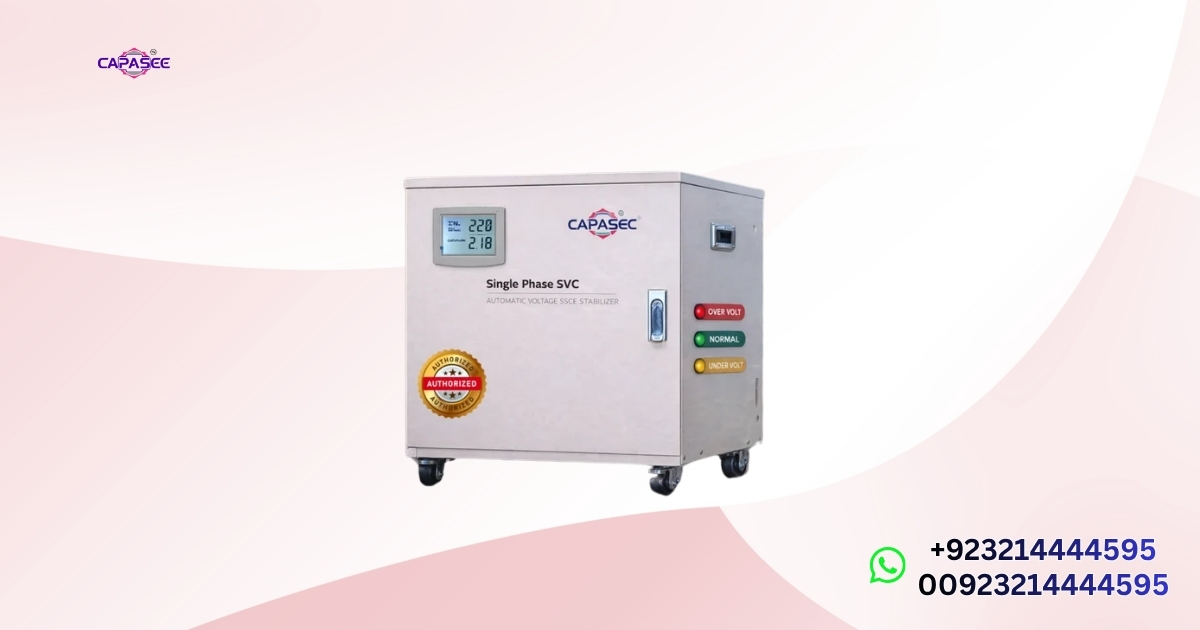
The key to every good stabiliser decision lies in the calculation of kVA. A unit that is either too large or too small wastes money, trips frequently, and overheats prematurely. The formula is easy: total wattage divided by 1,000 equals kW / power factor (0.8 for most setups) = kVA.
For instance, if the combined load of appliances in a home is 3,000W, a minimum 3.75 kVA stabilizer is required, and then adding a 20% safety margin to arrive at a target of around 4.5 kVA. Round up to the next standard size always.
How to choose stabilizer by kVA Calculation
The first step in kVA calculations is to make a list of all appliances that will operate during peak load. To find the minimum kVA required, multiply the wattage of each of the devices by its estimated runtime percentage, sum the values, and then divide the result by 800 (to compensate for the power factor). This process supports how to choose a stabilizer accurately.
If your home’s calculated demand is 4 kVA, purchase a 5 kVA unit. The small size increase is a little more expensive but results in years of life extension for the stabilizer and prevents a load increase. This is a practical approach to how to choose stabilizer units.
How to choose stabilizer by Input Voltage Range
The grid voltage in Pakistan varies from 160V in rural and semi-urban areas to as high as 260V during the non-peak hours. Your stabilizer’s input voltage range should be well suited to both ends; ideally, it should be rated for 130V to 280V input for 100% protection. Knowing voltage fluctuations is critical in choosing a stabilizer.
Narrow-range stabilizers will turn off or not correct voltage when the power surges the most, during peak voltage fluctuation. Before buying, make sure that the range of the input is specified on the datasheet. This is another aspect of how to choose a stabilizer effectively.
The following voltage calculation table is provided for reference in Pakistan.
| Device Type | Approx. Load | Recommended Stabilizer Type | Notes |
| Home main line | Medium to high (3 kVA to 8 kVA) | Servo stabilizer | Best for full-house protection across all appliances |
| Single AC unit | Medium (1.5 kVA to 3 kVA) | Servo or AVR | Inverter ACs need tight output tolerance |
| Office computers | Low to medium (1 kVA to 5 kVA) | Automatic voltage regulator | Good for IT load with stable output requirement |
| Office main line | Medium to high (5 kVA to 15 kVA) | Three-phase servo stabilizer | Covers mixed IT, HVAC and security loads |
| Hospital equipment | Sensitive / high (varies by device) | Servo or medical-grade stabilizer | Needs stable output within plus or minus 1% |
| Hospital main line | High (15 kVA to 30 kVA+) | Three-phase servo with isolation | Must include earthing and surge protection |
| Fridge and TV | Low (0.5 kVA to 1 kVA) | Relay-type or servo | Low-voltage cut-off essential for refrigerators |
Safety Margin for Voltage Fluctuation
Never add less than a 20% safety factor to the calculated load, or 25% for hospitals and industrial installations. This buffer takes up startup current surges, which on motors and compressors can be as high as three to six times as much as the normal running current and will instantly trip a small stabilizer. Safety margins are important in stabilizer planning.
A stabilizer that is always operating at 100% will overheat, shorten its own life, and give you no room for new equipment. Make it just the right size, and it will be quiet and dependable for many years. This final sizing check is part of how to choose stabilizer correctly.
FAQs
What size stabilizer do I need for home use?
The ideal size for the servo stabilizer for a full home in Pakistan is 5 KVA to 8 KVA. Single appliances need 1 kVA to 3 kVA units.
Which stabilizer is best for office equipment?
The most suitable device to deal with computers and networking is an automatic voltage regulator (AVR). A three-phase servo stabilizer is best suited for full office protection for the main line.
Can one stabilizer run all appliances in a house?
Yes, with a properly sized main line servo stabilizer correctly attached to your home distribution board, all the home appliances are protected simultaneously.
How do I calculate stabilizer capacity in kVA?
Add up all of the appliance watts and then divide by 800 to arrive at kVA, and then add 20% as a safety cushion.
What is the best stabilizer for hospital equipment?
An isolation transformer and medical grade servo stabilizer are best. It should allow a tolerance of ± 1% to ensure safe clinical use.
Is a servo stabilizer better than a normal stabilizer?
Yes, because servo stabilizers make a more gradual and continuous correction, they are the safer type of stabilizer to use with sensitive equipment, whereas relay-type units correct the voltage in rough steps.
Summary
From a family home in Rawalpindi to a corporate office in Karachi or a diagnostic clinic in Faisalabad, it is the ability to select the stabilizer properly that makes the difference between equipment that lasts 10 years and equipment that fails in 2 years. Match the stabilizer type to the load type, determine the kVA honestly, and never sacrifice the margin of safety. Use the information you have read here, and you will be able to make a more informed and confident purchase that will save you money on repairs. Contact Capasee Electro Medical Engineering today for expert load assessment and stabilizer suggestions for your particular configuration in Pakistan. If you understand how to choose stabilizer, you can make a better long-term investment.
The power grid won’t become stable on its own in Pakistan. Luck is not good enough for your equipment. Choosing a stabilizer remains one of the most important decisions for equipment protection.