

Blog
UPS Requirements for Ultrasound Machines in Pakistan

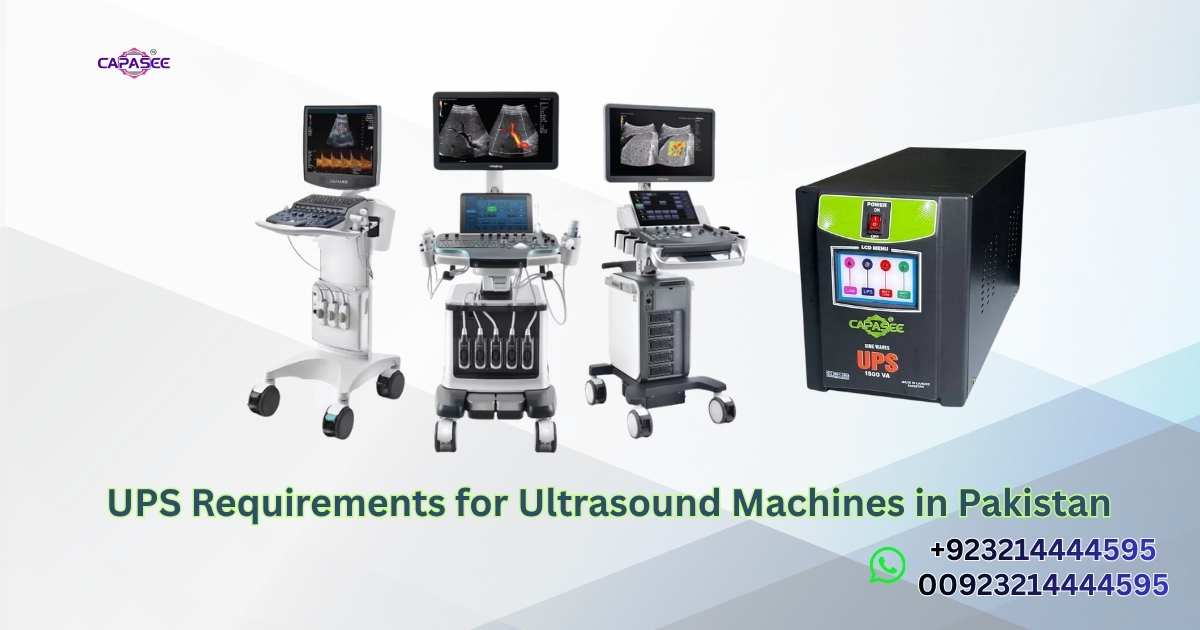
If a power surge happens for less than two seconds, it could permanently damage a million dollar ultrasound machine, and in Pakistan, the likelihood of a power surge is real. While most clinic owners and hospital procurement teams are thinking about the size of the ultrasound unit, they completely ignore the protection that should surround it, the properly sized, medically compatible UPS. The lack of planning could cause expensive repairs, loss of warranties, and unplanned downtime at the most inconvenient time.
Knowing the right UPS requirements for ultrasound machines in Pakistan is no longer discretionary but essential in the proper handling of medical devices. Capasee Electro Medical Engineering explains exactly what load capacity, wattage, output waveform, and backup runtime your ultrasound system requires to make an informed and confident purchase.
Why Ultrasound Machines Need UPS Protection in Pakistan
Ultrasound machines are very sensitive diagnostic equipment that must be powered safely and cleanly to operate properly. In Pakistan, the grid is not reliable at all in the cities and rural areas; running these machines without a proper UPS is alarming for some of the facilities and is a serious risk, which may cause their costly equipment failures. Understanding UPS requirements for ultrasound machines in Pakistan helps facilities reduce these risks.
Precision electronic components such as motherboards, transducer controllers, and imaging processors are sensitive to voltage spikes, voltage dips, and blackouts in medical imaging equipment, like ultrasound systems. The first and most important defence line between your equipment and the unpredictable electricity in Pakistan is a reliable UPS that meets UPS requirements for ultrasound machines in Pakistan.
Power Instability Problems Affecting Medical Ultrasound Equipment
Pakistan’s national grid is prone to load shedding; voltage fluctuations and frequency irregularities are common occurrences in the country, especially during the peak summer months. These conditions not only cause inconvenience, but they also work to damage the internal components of high dollar medical devices over time. This is why UPS requirements for ultrasound machines in Pakistan should be considered during equipment planning.
In the real world, in clinics in Lahore and Karachi, a common occurrence is the failure of the ultrasound probes before they are supposed to. This is caused by repeated micro interruptions in power. Many technicians believe this is due to overuse, but it is often caused by dirty power being fed in without filters or protection. Proper adherence to UPS requirements for ultrasound machines in Pakistan can help prevent such failures.
How UPS Prevents Data Loss and Equipment Damage
If the power goes out during the scan, patient information in temporary memory can become corrupted on the instant, requiring the examination to be repeated and delaying diagnosis. A UPS equipped with automatic voltage regulation (AVR) allows the machine to operate cleanly for brief outages, allowing operators time to save data and to shut down properly.
In addition to data protection, even the power supply prolongs the lifespan of the equipment on ultrasound machines. The facilities that have invested in an appropriate UPS according to UPS requirements for ultrasound machines in Pakistan have reported that they generally have much fewer power related component failure related service calls within the first three years of operation.
You May Also Read This Blog: How to Choose Stabilizer for Home, Office & Hospital in Pakistan
Essential UPS Specifications for Ultrasound Machines
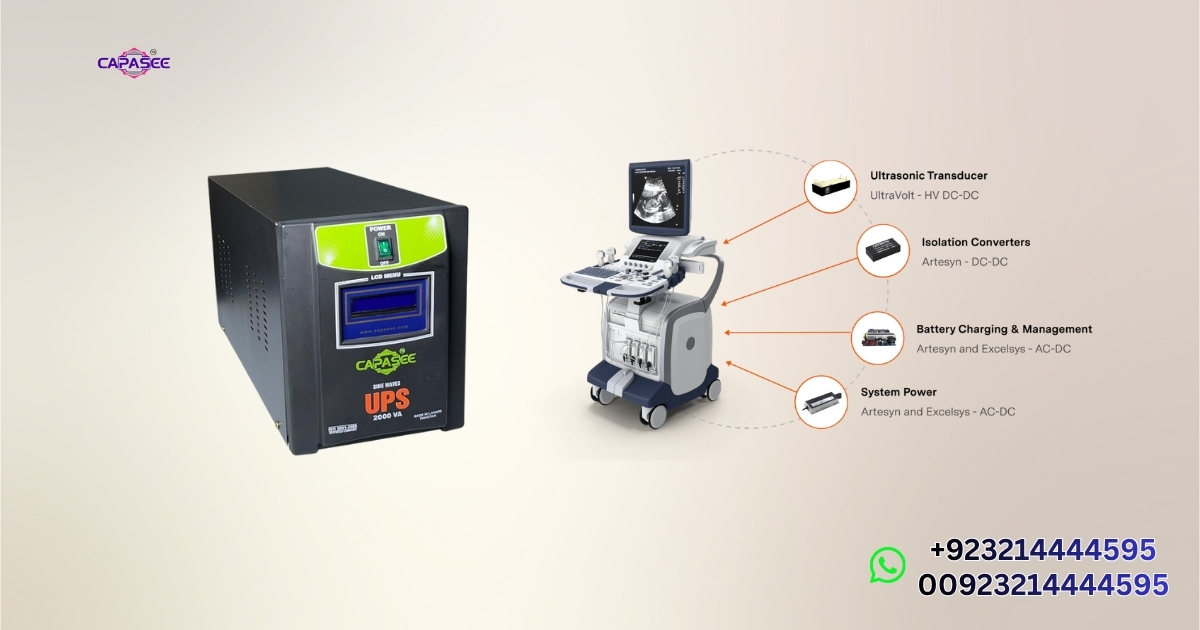
The selection of the correct UPS is not just about size. It allows one to match the output characteristics of UPS to the power requirements of the particular ultrasound system being used, depending on the type of machine, how long it is used and the configuration of the facility. Following UPS requirements for ultrasound machines in Pakistan ensures compatibility and protection.
Two facilities can have the same brand of ultrasound but different UPS setups, depending on the scan volume and the site. The key to a protected investment versus a vulnerable one is getting the calculation right. This is a major consideration in UPS requirements for ultrasound machines in Pakistan.
Calculating Correct UPS Wattage for Ultrasound Systems
The basic industry rule of thumb for sizing a UPS for an ultrasound machine is to include 25% as a safety factor. This buffer compensates for start up surge current, peripheral devices such as printers and monitors and the gradual degradation of battery performance.
To use the table below as a helpful guide for determining the appropriate wattage UPS for your ultrasound machine type:
| Ultrasound Machine Type | Typical Wattage | Recommended UPS Wattage (with 25% margin) | UPS Type Required |
| Portable Ultrasound | 150–250W | 300–350W | Battery Backup UPS |
| Standard Diagnostic Ultrasound | 400–600W | 500–750W | Online Double Conversion UPS |
| Advanced Cardiac Ultrasound | 700–1,000W | 900–1,250W | Industrial Online UPS |
| Doppler Ultrasound System | 500–800W | 625–1,000W | Online UPS with Surge Protection |
Check the machine’s specification sheet for its actual wattage, not just based on a best estimate. Even a 15% undersized UPS will overload during high scan times and will shut down unexpectedly. Accurate sizing is one of the core UPS requirements for ultrasound machines in Pakistan.
Key UPS Features Medical Facilities Must Require
Not all UPSs out there are appropriate for medical facilities. Healthcare facilities need to pay special attention to the pure sine wave output, the AVR and the isolation transformer when choosing a UPS for ultrasound protection in Pakistan.
Other essential features are battery health monitoring, the ability to shut down remotely and the input voltage range compatibility of the ultrasound system, usually 220V in Pakistan. If a UPS is missing one or more of these features, it may be able to start the device, but it will also allow damaging power quality problems to flow through unfiltered. These features are part of the recommended UPS requirements for ultrasound machines in Pakistan.
UPS Types Best for Ultrasound Machines in Pakistan
There are basically three types of UPS topologies; offline and standby UPS, line interactive UPS and online double conversion UPS. In Pakistan, only line interactive and online double conversion units are suitable for medical ultrasound equipment due to the country’s power situation and UPS requirements for ultrasound machines in Pakistan.
Offline UPS units are less expensive but have a transfer time of 5 to 25 milliseconds when a power outage occurs. That gap is sufficient to restart the sensitive ultrasound processors and disrupt the operation of a busy radiology department.
Online vs Offline UPS: Which Works for Medical Ultrasound?
Online double conversion UPS systems offer zero transfer time because the equipment that’s connected to the UPS is always powered by battery conditioned power instead of directly from the grid. This allows them to be the ideal option for high resolution, Doppler and advanced cardiac diagnostic systems, meeting UPS requirements for ultrasound machines in Pakistan.
For portable and simple diagnostic ultrasound equipment with budget limitations, line interactive UPS systems present a viable alternative. They control the voltage well and transfer in times of 24 milliseconds, which is okay for lower level systems but not desirable for critical imaging systems that must comply with UPS requirements for ultrasound machines in Pakistan.
Battery Backup Time Requirements for Healthcare Facilities
The hours of backup power needed for a medical facility will vary according to the type of facility. A small private clinic with outpatient scanners will require 10 to 20 minutes of backup time to finish the scan, save the data and then safely shut down according to UPS requirements for ultrasound machines in Pakistan.
For hospitals and diagnostic centres that have an ongoing imaging workflow, 30 to 60 minutes of backup is essential, especially in cities where load shedding timings are not fixed. For these applications, a combination of a high capacity UPS and generator handover system will provide the most robust configuration for continuous ultrasound operations while fulfilling UPS requirements for ultrasound machines in Pakistan.
Check More & Purchase: Our Products
Choosing the Right UPS Provider in Pakistan
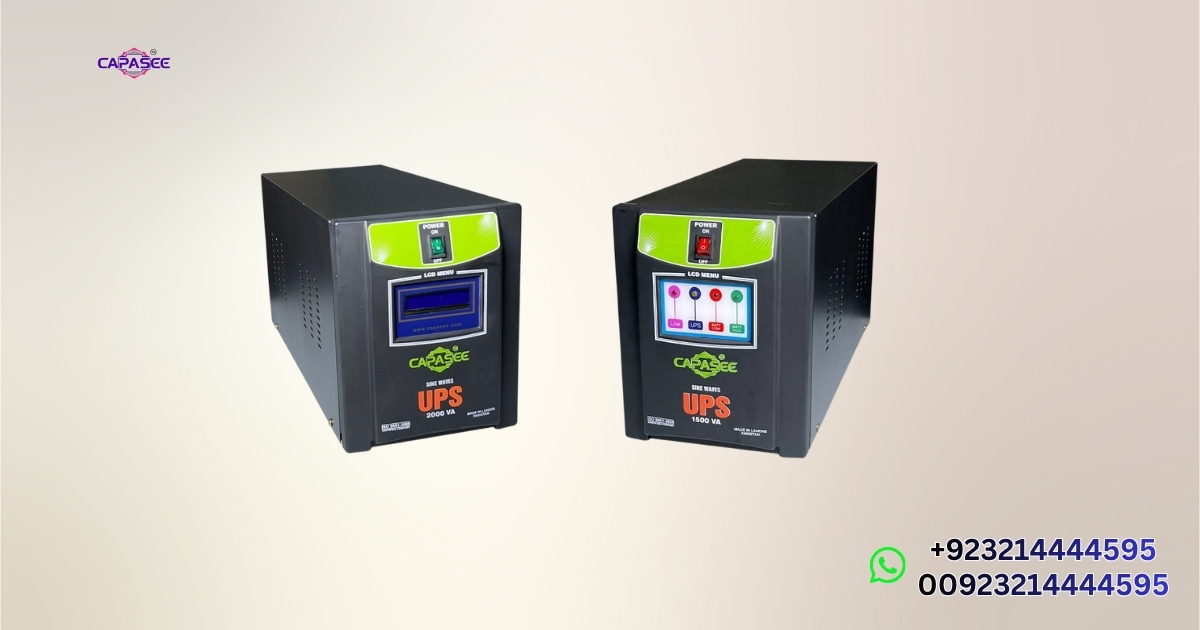
Shopping for a UPS vendor for medical equipment is not the same as shopping for consumer electronics. The provider needs to be aware of clinical environments, equipment compatibility, and technical requirements of healthcare grade power protection aligned with UPS requirements for ultrasound machines in Pakistan.
A vendor providing no knowledge of the load profile of ultrasound systems can only specify an inappropriate UPS unit that will be harmful. You should always use the services of a specialist in electromedical engineering and not one from a general electronics supply shop when evaluating UPS requirements for ultrasound machines in Pakistan.
Capasee Electro Medical Engineering Medical UPS Solutions
Capasee Electro Medical Engineering offers customised UPS solutions for the diagnostic imaging field in Pakistan. Capasee knowledge of ultrasound machine power requirements allows him to offer each facility the most accurate information about the UPS that will best fit their facility’s specific load profile with no compromises of protection or performance under UPS requirements for ultrasound machines in Pakistan.
Before recommending any UPS solution, Capasee team performs onsite power quality assessments. This is enough to avoid a common UPS size mismatching issue with medical devices, which is widely faced by many radiology practices in the private clinic segment of Pakistan and directly relates to UPS requirements for ultrasound machines in Pakistan.
Installation, Maintenance, and After Sales Support Criteria
A UPS for medical equipment is as reliable as the people who maintain it. Before accepting any system, make sure the provider can provide documentation of installation, load testing, and commissioning, as well as proof of professional installation with proper earthing, before turning it over in line with UPS requirements for ultrasound machines in Pakistan.
Capasee offers scheduled preventive maintenance services and battery replacement services as well as responsive after sales services across the major cities of Pakistan. Structured post sales commitments give you peace of mind for your facility when you select a provider and throughout the entire life of the UPS system, while supporting UPS requirements for ultrasound machines in Pakistan.
Frequently Asked Questions
How much does the UPS system cost in Pakistan?
The price of UPS systems in Pakistan varies from PKR 15,000 for basic models to PKR 200,000+ for industrial online systems, depending on capacity and type.
What is the price of a 3000 watt UPS in Pakistan?
The price of a 3000 watt online UPS in Pakistan is in the range of PKR 80,000 to PKR 160,000, depending on the brand, battery backup time, and type of sine wave output.
What is the price of a 1.5 KVA UPS in Pakistan?
The price of a 1.5 KVA UPS in Pakistan is in the range of PKR 25,000 to PKR 55,000. Medical grade pure sine wave models are towards the top of this range.
What is the price of a 1000VA UPS in Pakistan?
The price of a 1000VA UPS in Pakistan ranges from PKR 15,000 to PKR 35,000. Medical equipment pure sine wave models are more costly than other models.
What size UPS do I need for an ultrasound machine?
Add 25% to the wattage of your machine. The required UPS capacity is a 500 to 750W UPS capacity minimum pure sine wave.
Why is UPS important for medical ultrasound equipment in Pakistan?
The frequent load shedding and voltage fluctuations in Pakistan affect the ultrasound circuits and also cause patient data corruption. A medical UPS ensures continuity of diagnosis and prevents equipment failure.
Can I use a regular home UPS for ultrasound machines?
No, Home UPS produces modified sine wave outputs, which are not suitable for use with ultrasound machines. Pure sine wave UPS models can only be used with medical imaging equipment.
How long should UPS battery backup last for ultrasound systems?
A minimum of 10 minutes is required for clinics. During the unpredictable load shedding periods in Pakistan, the hospital or diagnostic centres will take 30 to 60 minutes to do the scans safely.
What UPS type is best for cardiac ultrasound machines?
For cardiac ultrasound, the best UPS is an online double conversion UPS. It offers zero transfer time, pure sine wave output, and complete isolation from the unstable grid supply in Pakistan.
Where can I buy medical grade UPS in Pakistan for ultrasound equipment?
Capasee Electro Medical Engineering provides medical grade UPS in Pakistan with on site assessment, proper sizing, professional installation, and dedicated after sales support.
Summary
The key to using the right power protection is as important as the equipment you use. These are the three choices that can make the difference between safe and unsafe operation of your ultrasound machine; matching UPS wattage properly, choosing pure sine wave output, and determining backup runtime. These factors are central to UPS requirements for ultrasound machines in Pakistan.
The facilities that adopt these specifications do not have to endure expensive repairs, have continuity in diagnosis, and greatly prolong the service life of imaging equipment. The UPS requirements for ultrasound machines in Pakistan are quite simple once you grasp their basic aspects.Call Capasee Electro Medical Engineering to discuss your site and obtain a free quote. Your gear can be a significant investment, and you want protection at least commensurate with that investment while meeting UPS requirements for ultrasound machines in Pakistan.